Templates & Toolkits
Practical, ready-to-use quality tools — built by working auditors, in plain English. Every product shows you exactly what's inside before you buy, and downloads are instant.
Instant download, no delivery charge, and a 14-day full refund on every paid toolkit — no reason needed.
Choose by task
Move to the 2026 editions
Size the gap to ISO 9001:2026 or ISO 14001:2026, then plan the transition.
Write the ISO 9001 documentation
A manual, procedures and registers that arrive written — or the register to control your own.
Fix a recurring problem
8D to find and remove the root cause, and the trackers that keep concerns moving.
- 8D Problem-Solving Toolkit · $29
- Problem-Solver Pack · $49
- Fast Response Tracker free
- NC Writing Checklist free
- Constraint Finder free
Build the core tools
Process flow → PFMEA → control plan → SPC, on one set of operation numbers.
- PFMEA Toolkit · $29
- SPC Control Chart Toolkit · $29
- Process Flow Template free
- Control Plan Template free
- MSA / Gage R&R Study Template free
- Cpk Calculator free
Set up food safety
HACCP from the flow diagram up, and the FSSC 22000 Version 7 upgrade.
Add information security (ISO/IEC 27001)
Size the gap against ISO/IEC 27001:2022 — the clauses and all 93 Annex A controls — before you build the ISMS, with the whole of Annex A on one page.
Use AI for quality work
Ready-made AI assistants for findings, audit checklists, 8Ds, root cause and quality documents — for Claude, ChatGPT, Copilot and Gemini.
Work at height (South Africa)
The paperwork Construction Regulation 10 asks for, and free training for the crew.
Toolkits
Everything Bundle (five toolkits)
Five toolkits in one purchase: the 50-document ISO 9001 Documentation Toolkit plus the ISO 9001:2026, ISO 14001:2026, 8D and SPC toolkits — the lowest per-tool price we offer.


Real pages from the actual file — click any preview to enlarge.
- The ISO 9001 Documentation Toolkit — 50 documents: fully-written quality manual, ten procedures, 28 forms & registers, a 51-question audit checklist and a Start Here guide — the ISO 9001:2026 edition ($99 on its own)
- ISO 9001:2026 Transition Toolkit — gap checklist, clause guidance and an action plan for the new edition ($29)
- ISO 14001:2026 Transition Toolkit — the same, clause-mapped for the environmental standard, with the updated registers ($29)
- 8D Problem-Solving Toolkit — a full D0–D8 Excel workbook with Is/Is-Not, the 3-legged 5-Why and an Ishikawa canvas ($29)
- SPC Control Chart Toolkit — X̄-R, X̄-S, I-MR and p/np/c/u charts with automatic control limits ($29)
- Every toolkit in the bundle that follows a 2026 standard is its published-standard edition: the ISO 9001:2026 and ISO 14001:2026 Transition toolkits and the ISO 9001:2026 edition of the Documentation Toolkit
What you still have to do
Everything in the five toolkits, adapted the way you would adapt each one — see each product for exactly what it contains and what you tailor. One purchase, one organisation licence.
For: Quality and EHS managers standing up or upgrading a management system who want the documentation, both 2026 transitions, problem solving and process control at the lowest per-tool price.
ISO 9001 Documentation Toolkit (50 documents)
Stop writing your QMS from a blank page: a fully-written quality manual, ten complete procedures and the working forms, logs and registers behind them — one numbering scheme, already cross-referenced, ready to adapt.


Real pages from the actual file — click any preview to enlarge.
- Quality manual fully written clause-by-clause (two options), with a matrix mapping every ISO 9001:2026 clause to the document that answers it
- Ten complete procedures — document control, internal audit, nonconformity & corrective action, management review (all eight 2026 inputs), risks and opportunities (each on its own scale), training, suppliers (score bands), complaints (response targets), calibration, change management
- Written prose, not fill-in-the-blanks: the ten procedures need just 34 fields between them, and 30 of those are revision dates and approver names
- 28 forms, logs & registers — the Excel registers with dropdowns, automatic calculations and overdue highlighting built in
- 51-question internal audit checklist on the ISO 9001:2026 clause structure, with C/NC/OFI dropdown and automatic result summary, plus a Start Here guide with a 12-week path and a map of every 2026 change
What you still have to do
Written, but not drop-in. Around 85 marked «fields» across the manual, policy and all ten procedures become your own details, and where your organisation genuinely works differently you change the words — an auditor checks what you do against what you wrote. Adopt what fits, adapt what nearly fits, delete what doesn't apply. Budget a day to make it yours.
For: Quality managers implementing ISO 9001 from scratch, certified organisations upgrading tired documents, and teams who want a system they can maintain themselves.
2026 Transition Pack — ISO 9001 + ISO 14001
Both 2026 transition toolkits in one purchase: gap checklists, clause-by-clause guidance and phased action plans for the quality AND environmental standards — the pack for integrated-system teams.


Real pages from the actual file — click any preview to enlarge.
- ISO 9001:2026 Transition Toolkit — a 31-point gap checklist across every change area (climate context, culture & ethics, the risk/opportunity split, planning of changes, management review, the clause 10 renumbering, Annex A), clause guidance and a phased action plan; Version 2.0, aligned to the published text ($29 on its own)
- ISO 14001:2026 Transition Toolkit — 18-point gap checklist, clause guidance and a phased plan to the 30 April 2029 deadline, with updated registers built in ($29 on its own)
- One consistent method across both standards — the same gap → guidance → action-plan structure, so one team can run both transitions
- Both toolkits are the published-standard editions, with free updates for 12 months after purchase
For: Quality and EHS managers running an integrated (QMS + EMS) system, and consultants moving clients through both 2026 transitions.
Problem-Solver Pack — 8D + SPC
Solve the problem, then prove it stays solved: the full D0–D8 8D workbook to find and fix the root cause, plus the SPC Control Chart Toolkit to keep the process in control afterwards.


Real pages from the actual file — click any preview to enlarge.
- 8D Problem-Solving Toolkit — complete D0–D8 report with Is/Is-Not, the 3-legged 5-Why and an Ishikawa canvas built in ($29 on its own)
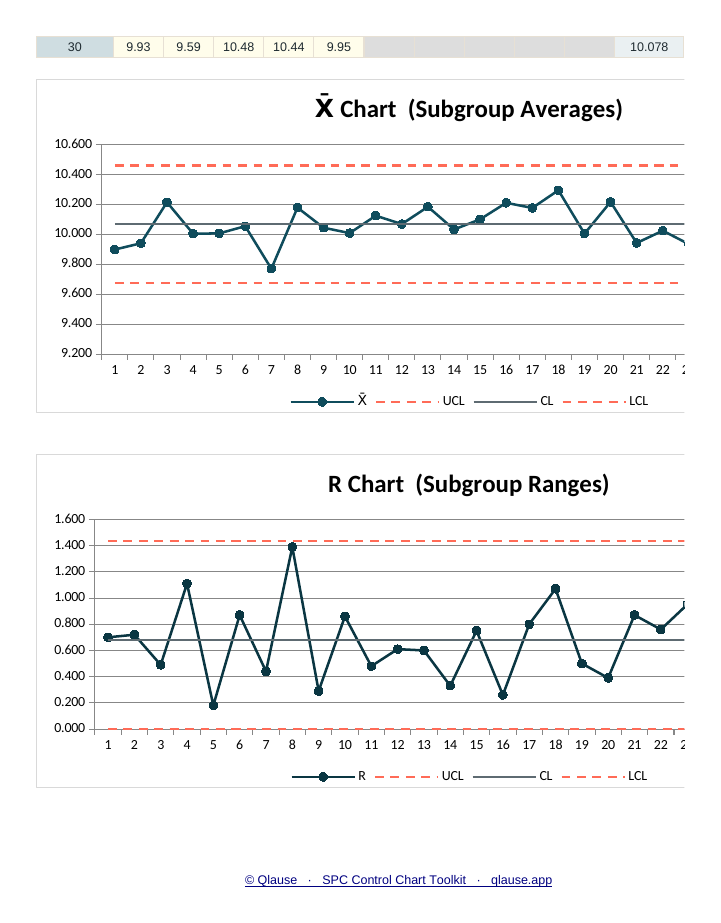
- SPC Control Chart Toolkit — X̄-R, X̄-S, I-MR and p/np/c/u charts with automatic control limits, spec fields and a Start Here guide ($29 on its own)
- The natural pairing: D7 prevent-recurrence hands over to the control chart — the 8D proves the fix, SPC proves it holds
- Plain Excel, no macros or add-ins — fill the yellow cells and the tools do the maths
For: Quality and process engineers answering customer complaints and 8D requests who then need ongoing evidence of control for audits and customer scorecards.
Work at Height Compliance Pack
Everything Construction Regulation 10 asks a South African site for, written and ready to make yours: the fall protection plan, the risk assessment behind it, the rescue plan, and the equipment register that keeps itself honest.


Real pages from the actual file — click any preview to enlarge.
- Fall Protection Plan Template — 12 sections covering all five parts Regulation 10(2) requires, written in prose you edit rather than blanks you guess at
- Fall Risk Assessment (Excel) — live 5×5 scoring before and after controls, a worked roof-work example scored end to end, rating guidance and a task library of fall risk positions
- Fall Protection Equipment Register (Excel) — every harness, lanyard, retractable, anchor and rescue item with its standard and interval; next-due dates and status calculate themselves and turn red when they lapse
- Rescue Plan Template, rescue drill record and knots card — the part most sites are missing, since a harness with no way down is a countdown, not a control
- Pre-use inspection sheet, fall clearance worksheet, lifeline installation checklist and a practical observation checklist mapped to every assessment criterion of US 229998
- All three knowledge tests with trainer answer keys, plus a Certificate of Attainment issued by your organisation — Word and Excel throughout, so every word is yours to change
What you still have to do
Templates, not a signature. A fall protection plan is only valid once a competent person appointed under Regulation 10(1) has written it for your actual site and signed it, and nothing in this pack replaces accredited training, practical assessment by a registered assessor, or the Annexure 3 medical certificate of fitness.
For: Safety officers, SHEQ managers, contractors and competent persons appointed under Construction Regulation 10(1) — roofing, solar, sheeting, maintenance and construction work in South Africa.
HACCP Plan Toolkit (Excel) — the Codex 12 steps
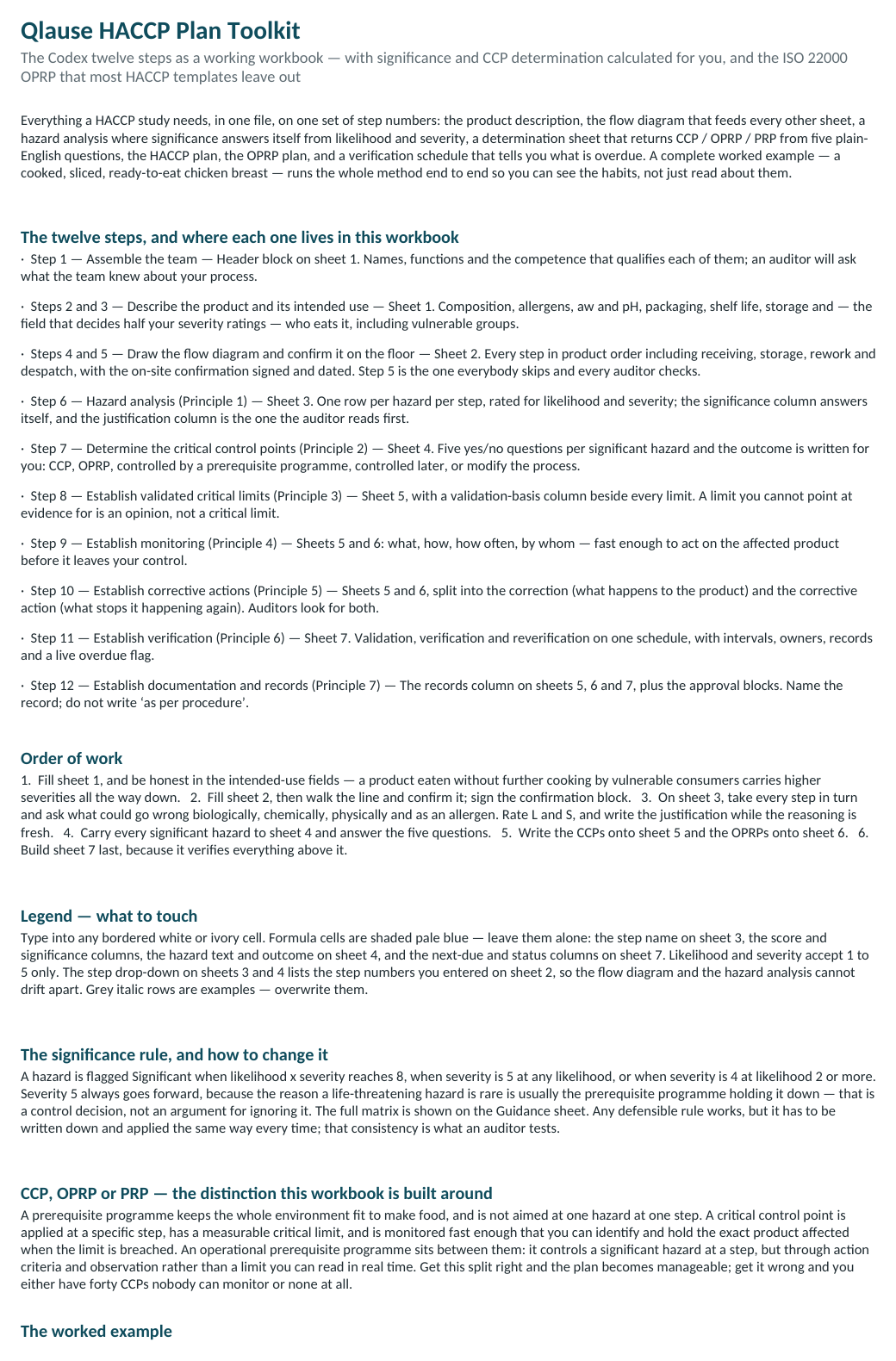
A complete HACCP study in one workbook: rate likelihood and severity and the significance answers itself; answer five plain-English questions and the workbook tells you whether it is a CCP, an OPRP or a prerequisite programme.
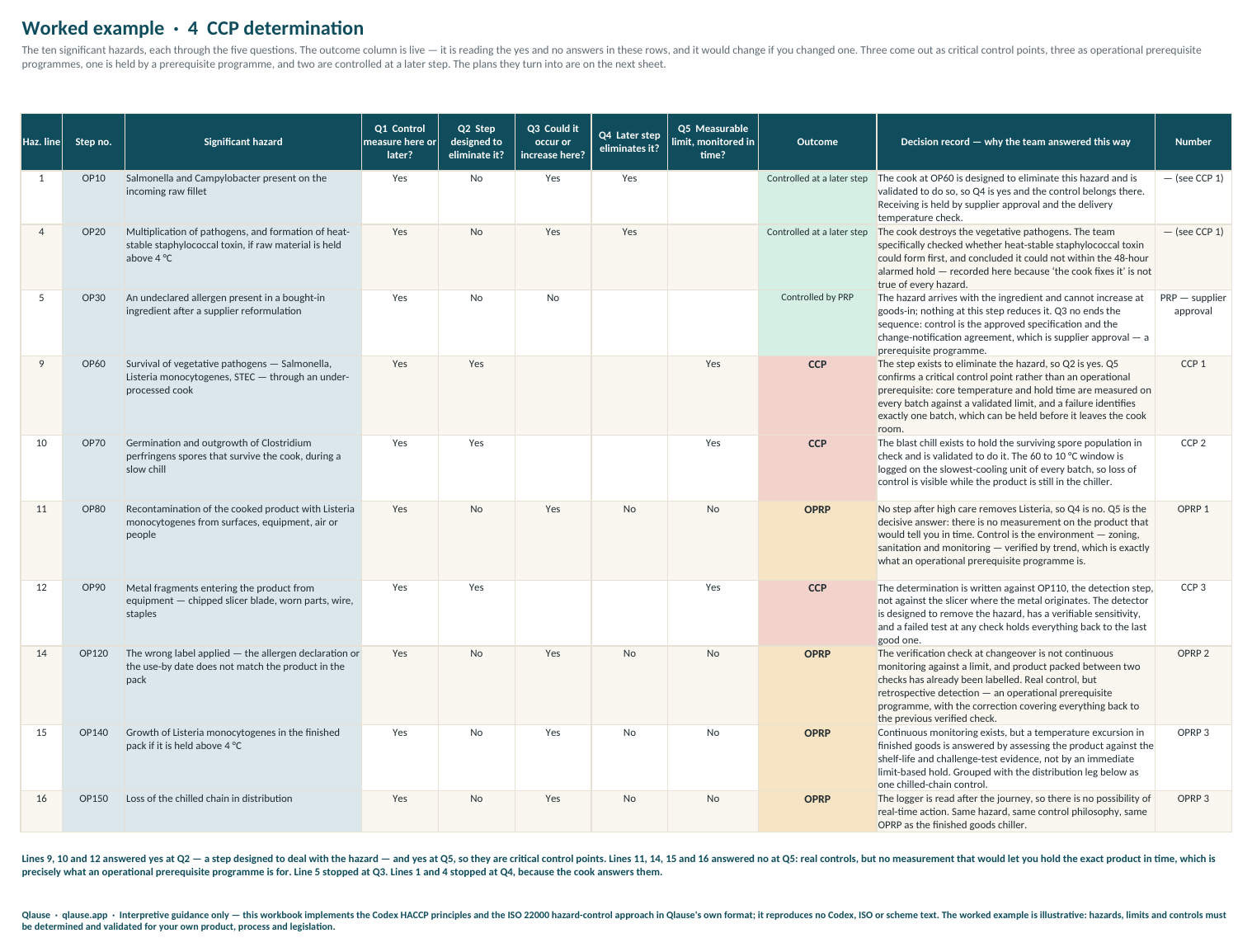
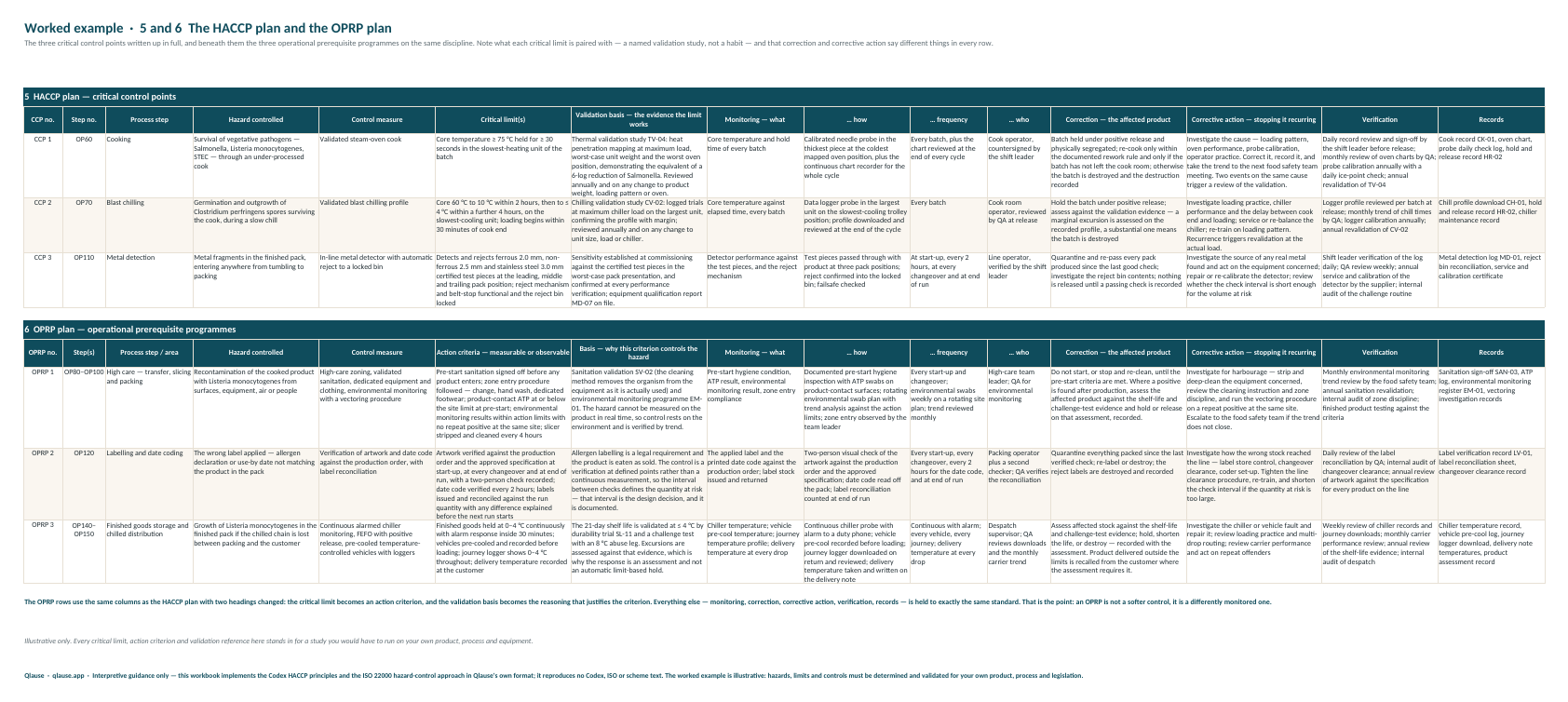
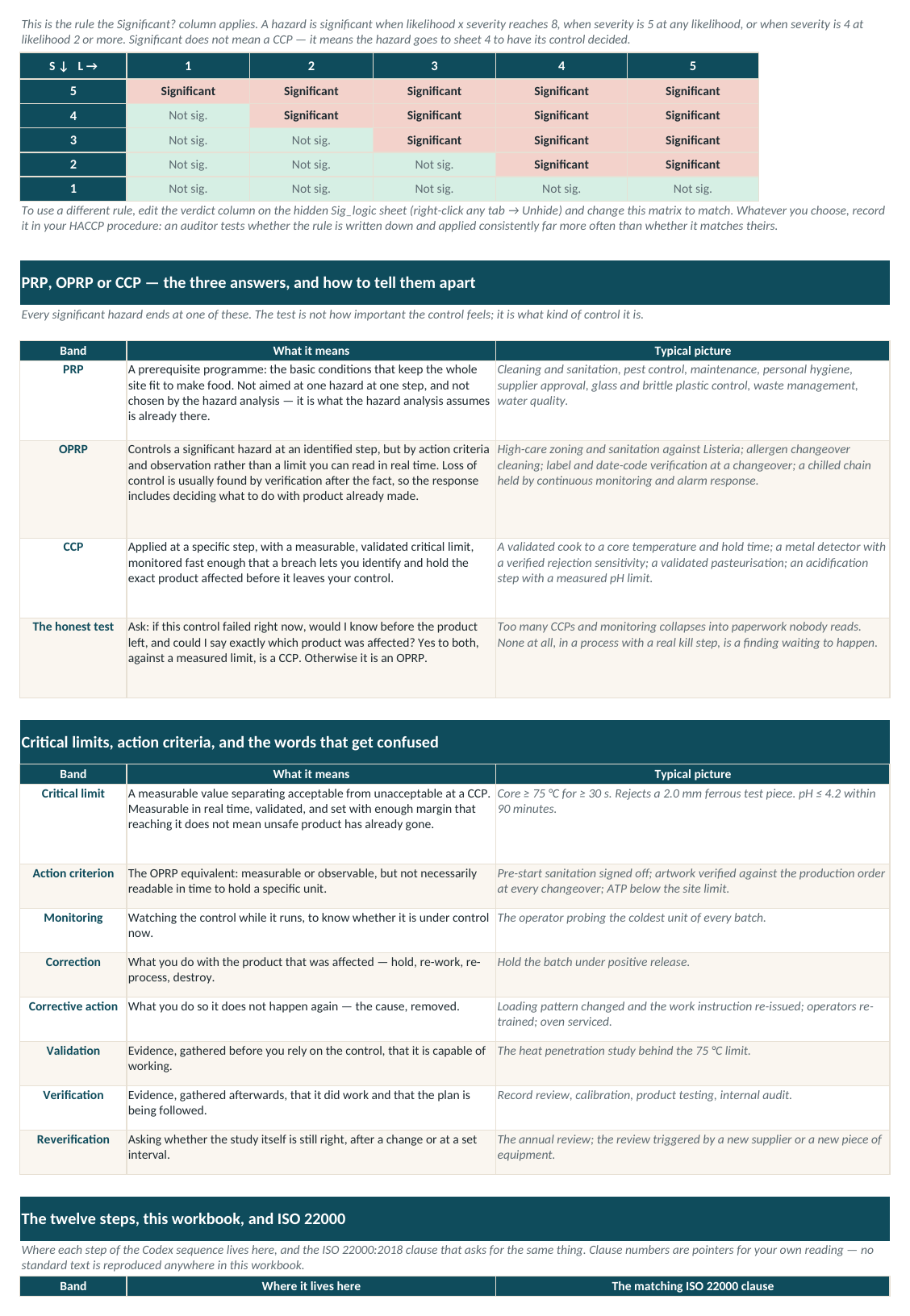
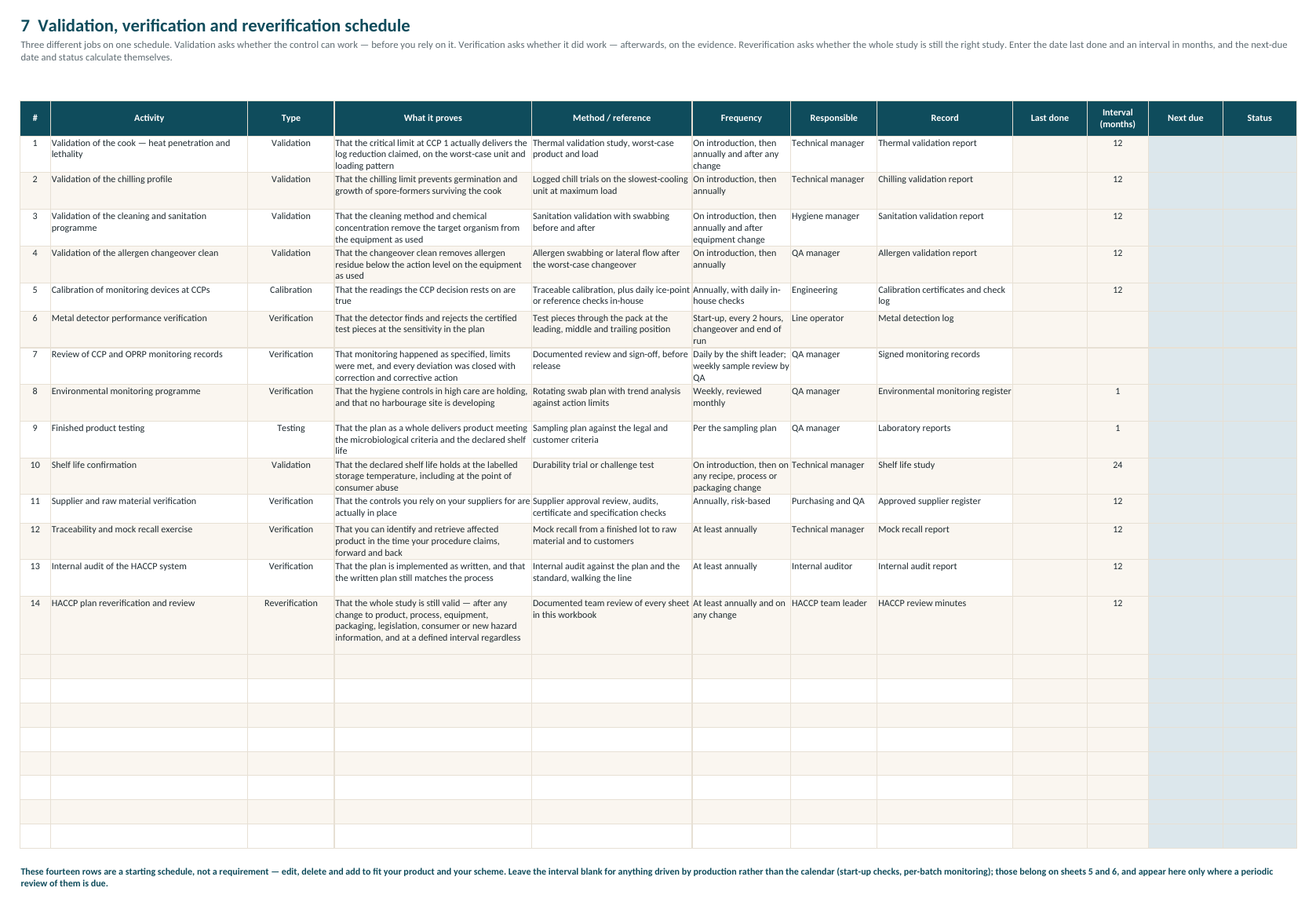
Real pages from the actual file — click any preview to enlarge.
- Seven working sheets in Codex order on one set of step numbers — product description and intended use, process flow with the on-site confirmation block, hazard analysis, CCP determination, the HACCP plan, the OPRP plan and a verification schedule — plus a start-here guide and a guidance sheet
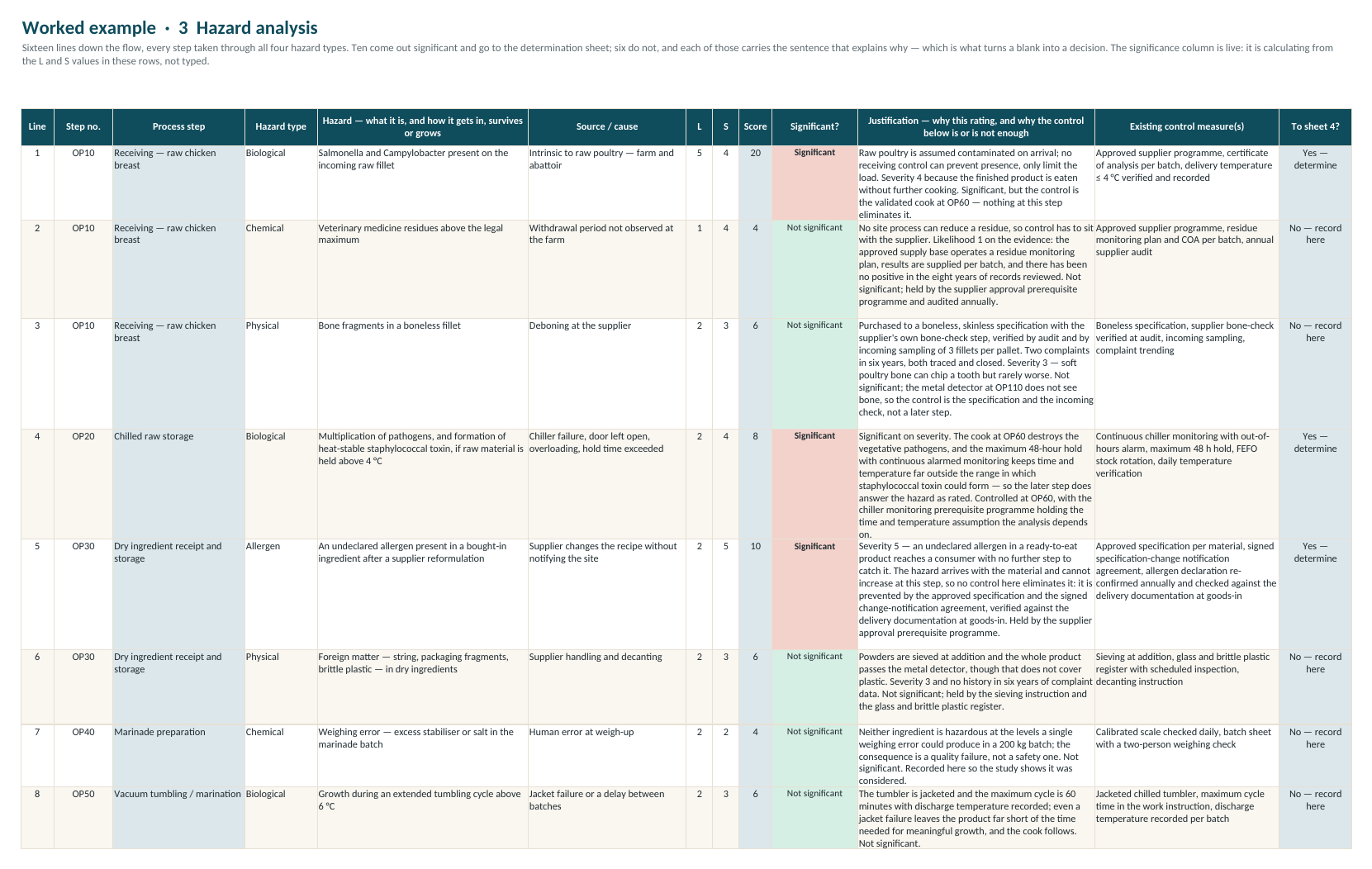
- Hazard significance calculated from likelihood × severity against a documented, editable rule — with the full matrix shown and the justification column an auditor reads first
- CCP determination answered by formula: five yes/no questions return CCP, OPRP, controlled by a prerequisite programme, controlled at a later step, or modify the process — colour-coded, with a decision-record column
- Critical limits paired with a validation-basis column, monitoring split into what / how / how often / by whom, and correction kept separate from corrective action (both plans print on A3)
- Validation, verification and reverification schedule with fourteen activities already written, intervals, owners, records and a live Overdue / Due soon / OK flag
- A full worked example across five sheets — a cooked sliced ready-to-eat chicken breast: fifteen process steps, sixteen hazard lines, ten determinations, three CCPs and three OPRPs written out in full
What you still have to do
The worked example is illustrative, not a plan you can adopt: every hazard, critical limit and control has to be determined and validated on your own product, process and legislation. Where your scheme, customer or national legislation prescribes a particular decision tree or plan format, use theirs — the reasoning in this workbook transfers. This is an independent template, not accredited training and not a food-handler or Person-in-Charge certificate.
For: Food safety and quality managers, technical managers and HACCP team leaders building or rebuilding a study — to Codex, ISO 22000, FSSC 22000, BRCGS or national food legislation.
ISO 27001 Risk Assessment & SoA Toolkit (Excel) — risks in, Statement of Applicability out
Score your information security risks on a documented method, pick the Annex A controls that treat them, and the Statement of Applicability writes its own first draft — every justification citing the risks behind it.
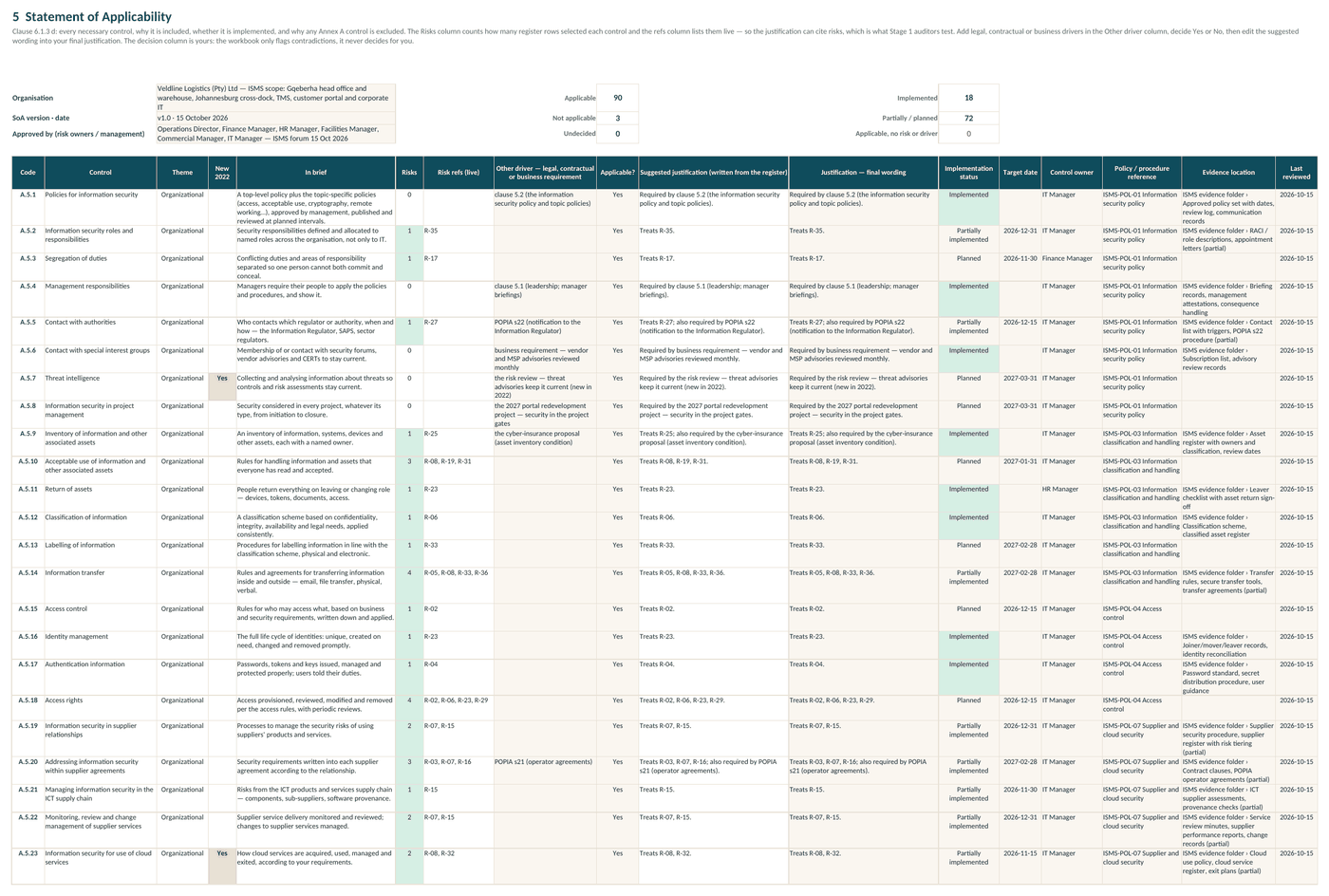
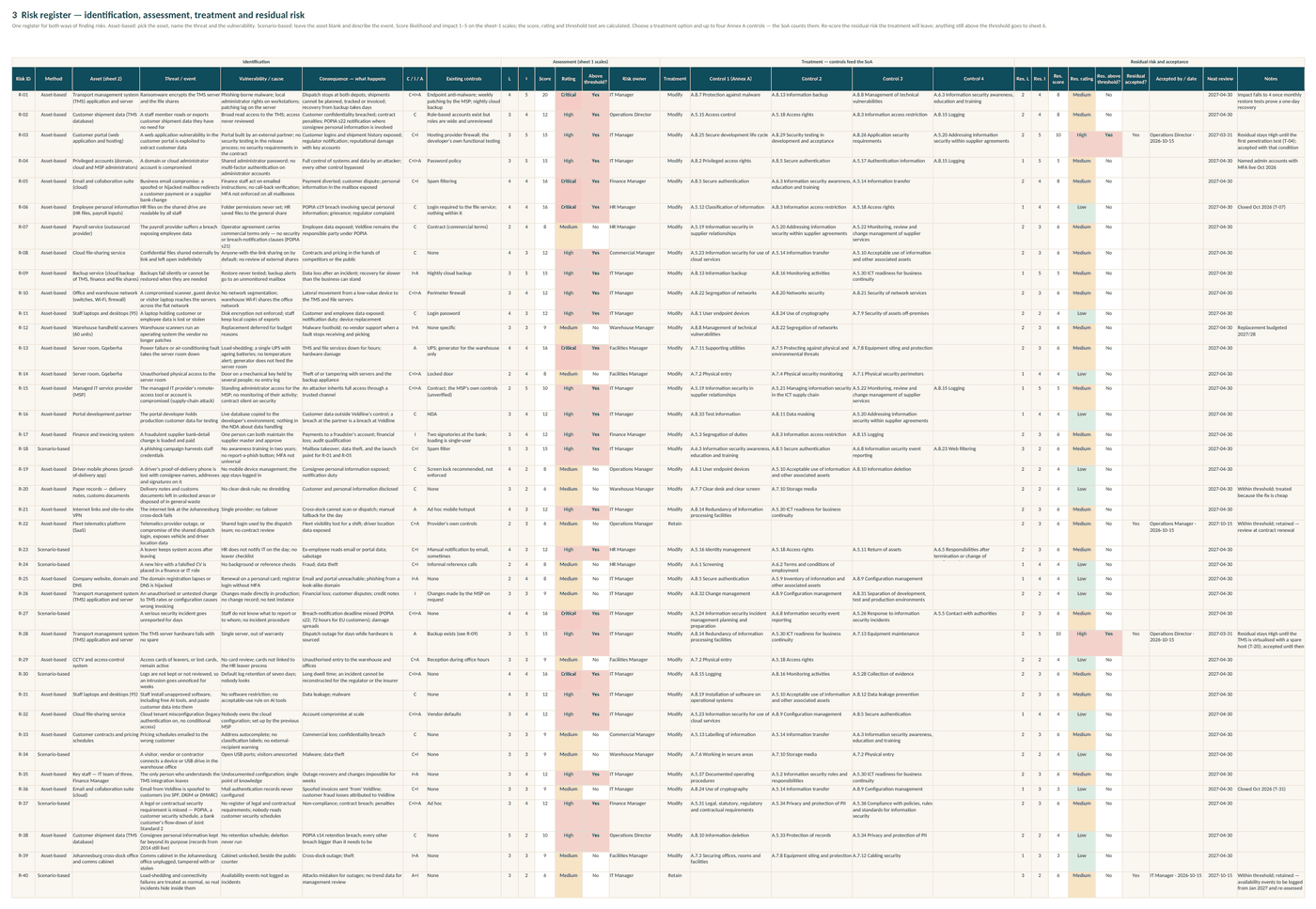
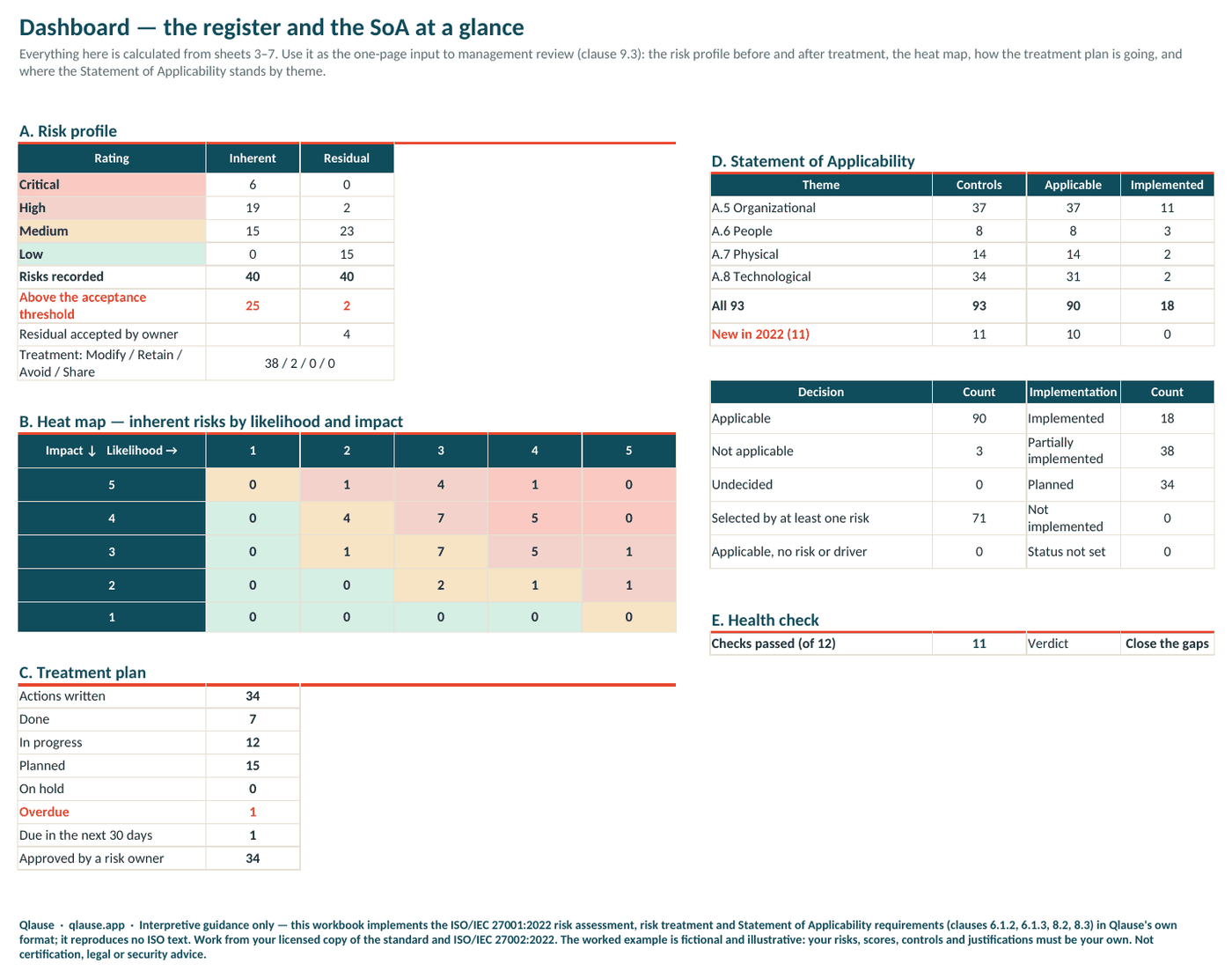
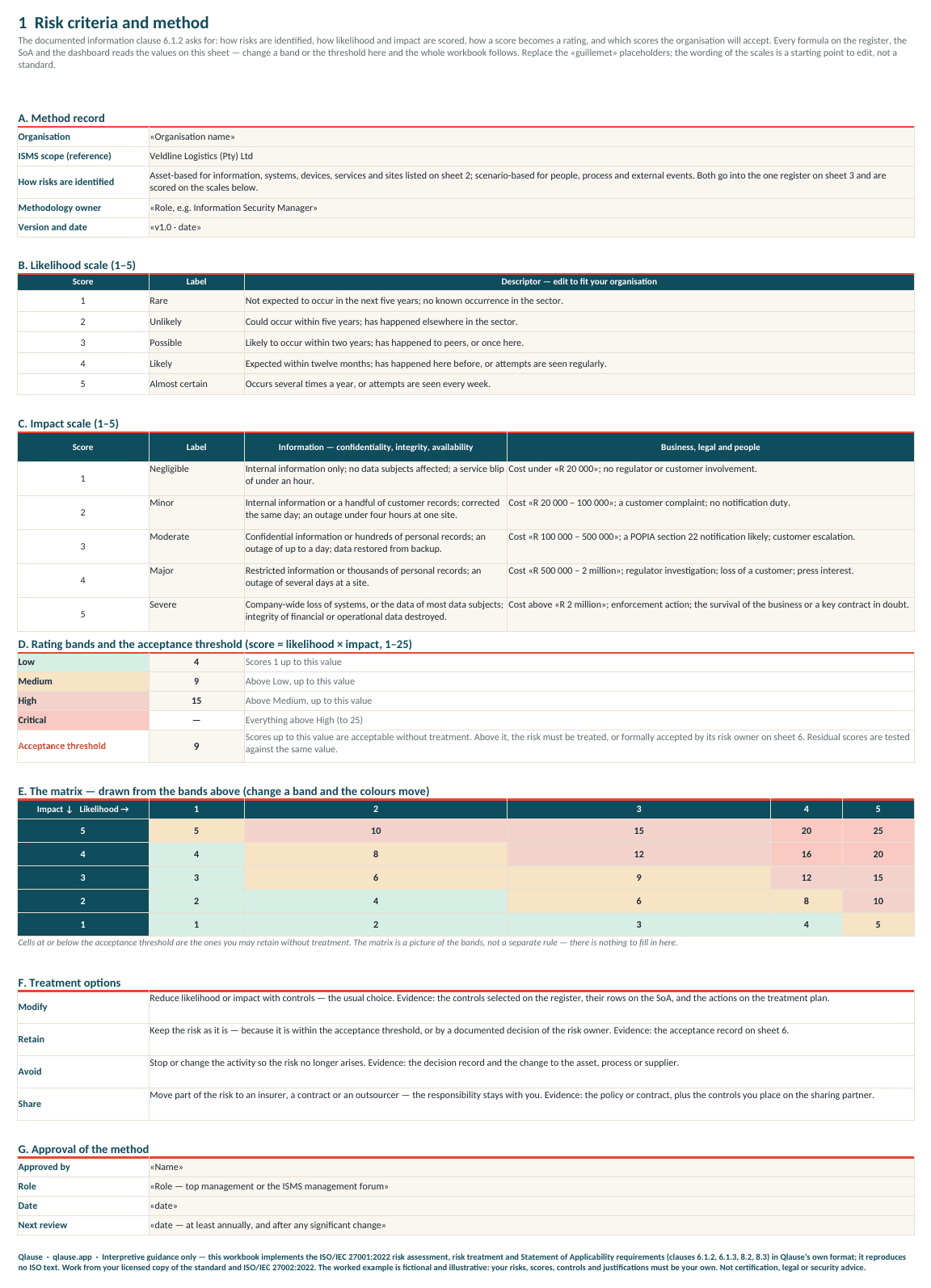
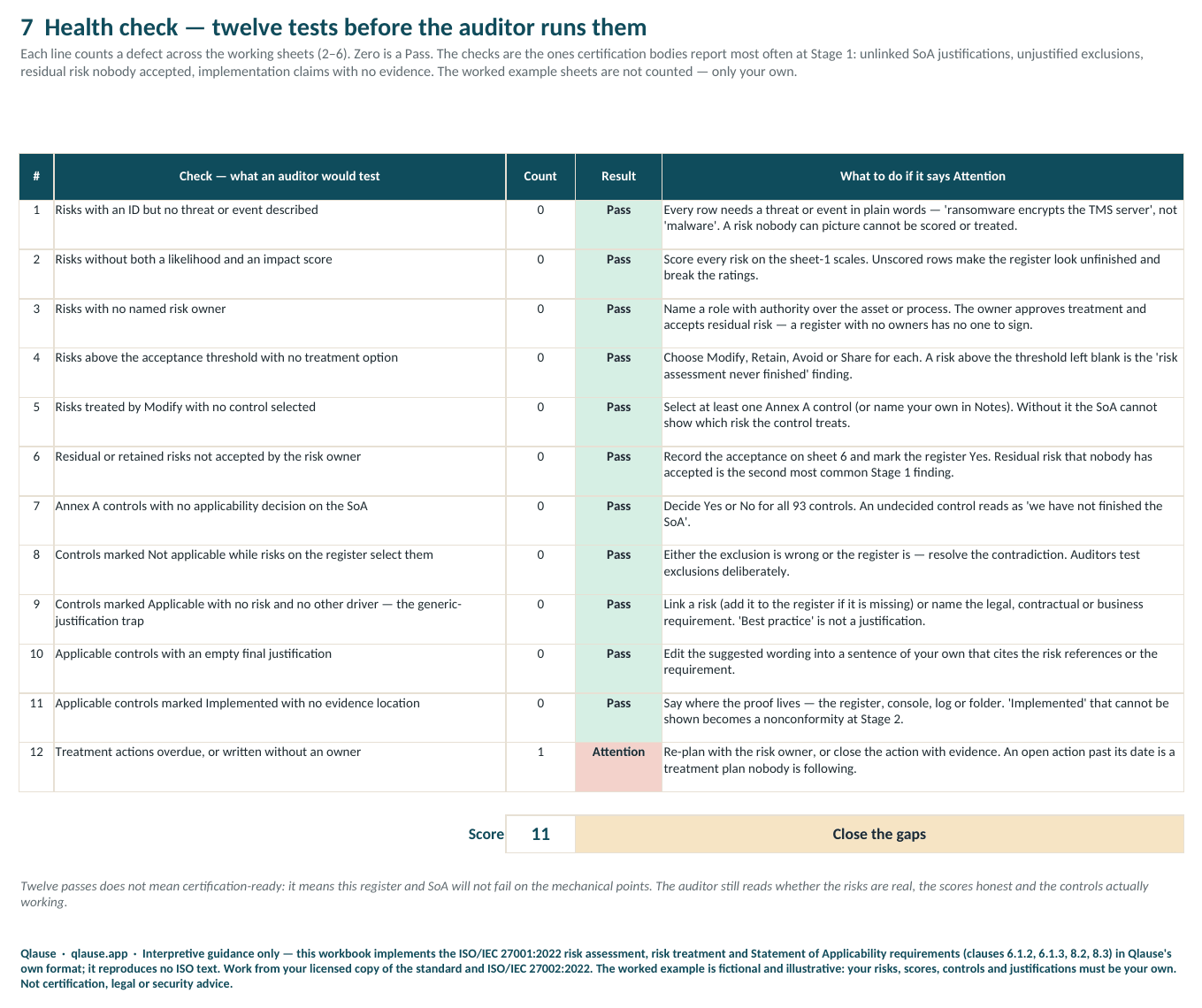
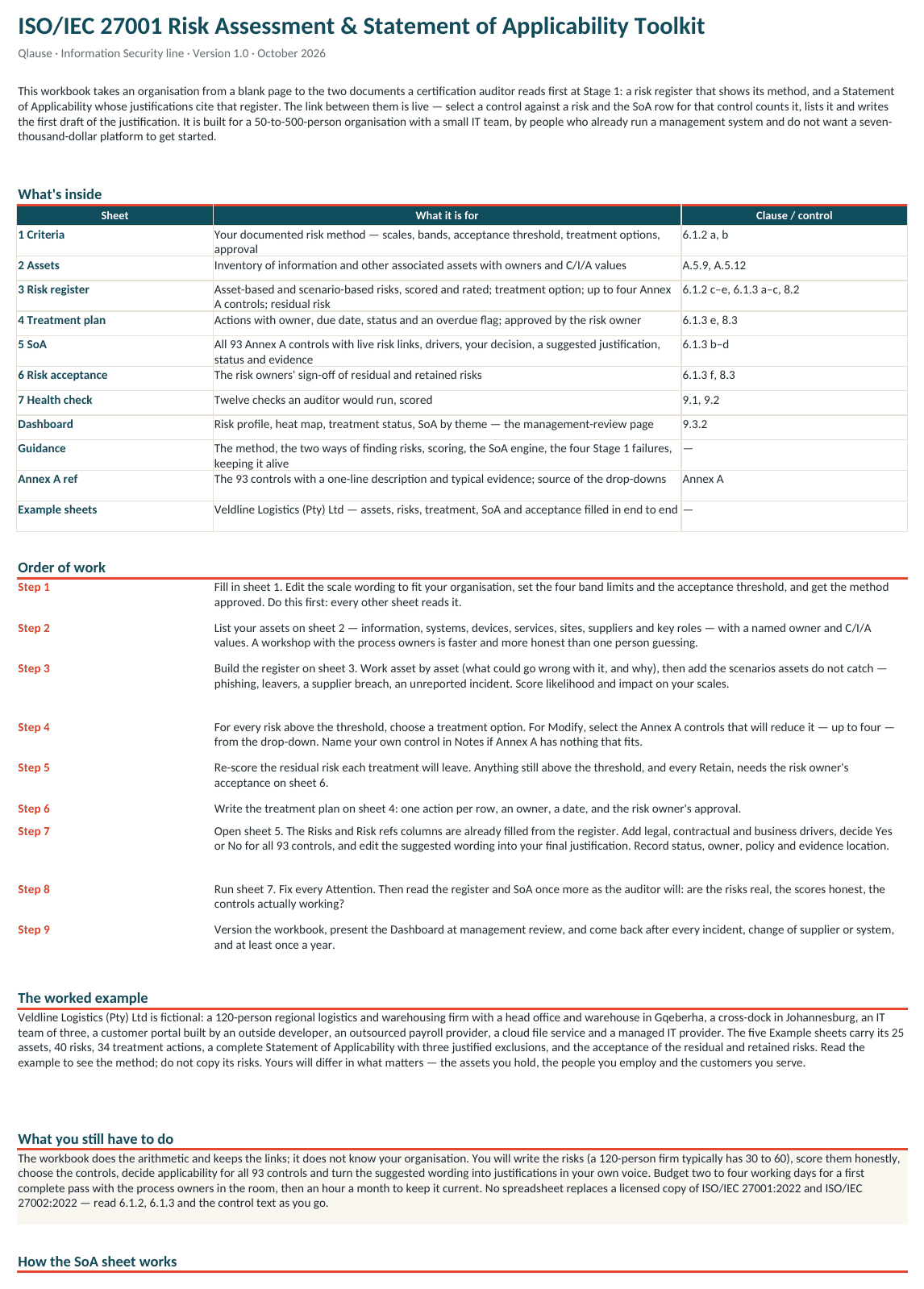
Real pages from the actual file — click any preview to enlarge.
- A documented risk method on one sheet — likelihood and impact scales, rating bands and an acceptance threshold that every other sheet reads, with the 5×5 matrix drawn live from those bands (clause 6.1.2)
- Asset inventory (A.5.9) with owners and C/I/A values, feeding a 120-row risk register that takes asset-based and scenario-based risks in one list; score, rating and the threshold test are calculated, with up to four Annex A controls per risk
- Statement of Applicability for all 93 Annex A controls: the workbook counts the risks that select each control, lists them live, writes a suggested justification from the register — 'Treats R-04, R-18; also required by POPIA s21…' — and flags the two Stage 1 failures: an exclusion that contradicts the register, and an applicable control with no risk or requirement behind it
- Treatment plan with a live overdue flag and the risk text, controls and residual rating pulled from the register; a risk-acceptance sheet for the risk owners' sign-off (6.1.3 f)
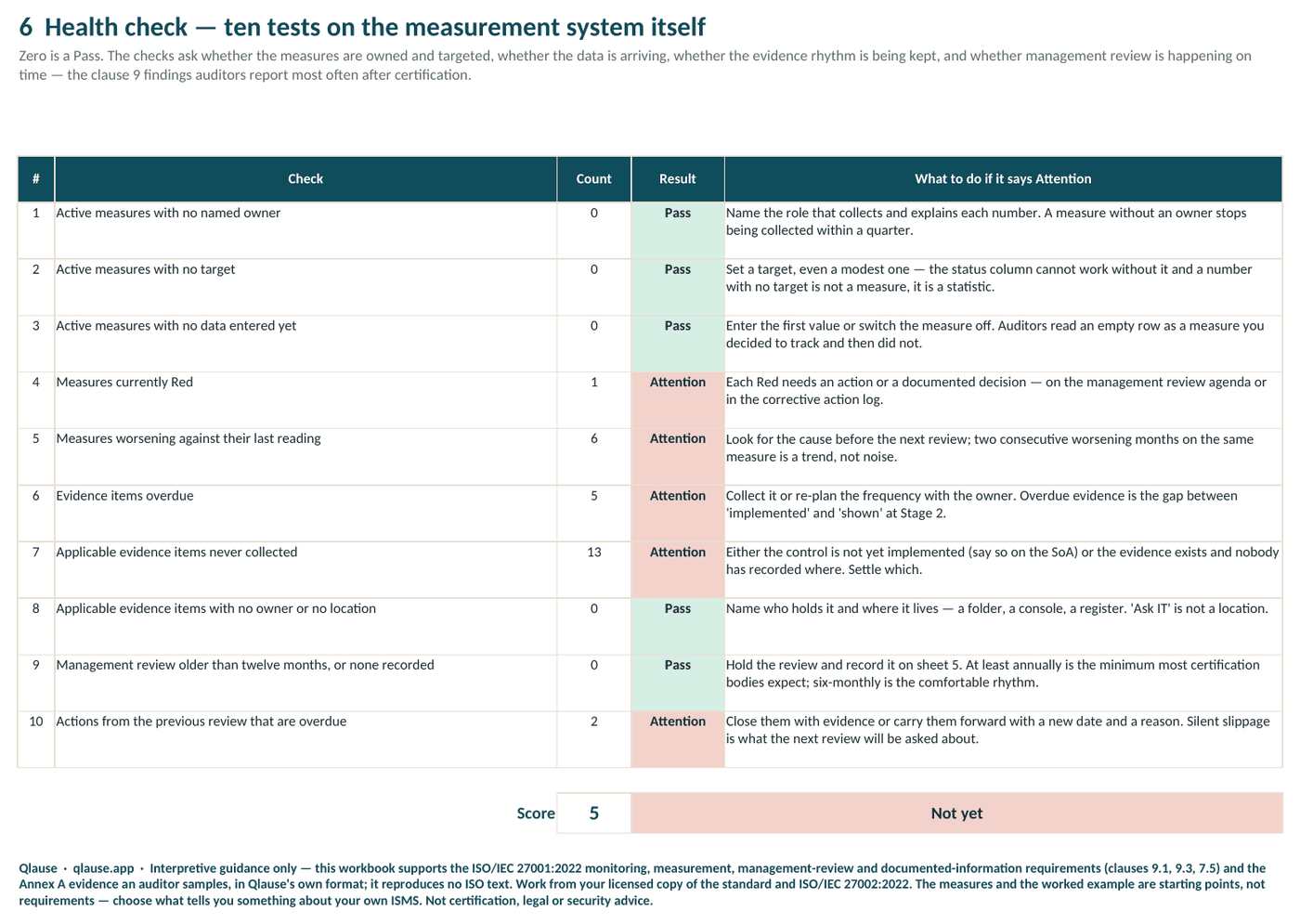
- Twelve-point health check scored out of twelve — the tests certification bodies run most often at Stage 1 — and a one-page dashboard built as the management-review input (9.3)
- A complete worked example on a fictional 120-person logistics firm: 25 assets, 40 risks, 34 treatment actions, the full SoA with three justified exclusions, and the acceptance record
What you still have to do
The workbook does the arithmetic and keeps the register and the SoA in step; it does not know your organisation. You still write the risks (a 120-person firm typically has 30 to 60), score them honestly, choose the controls, decide applicability for all 93 controls and turn the suggested wording into justifications of your own — budget two to four working days for a first pass with the process owners in the room. The live risk-references column uses TEXTJOIN (Excel 2019 / Microsoft 365, or LibreOffice); in Excel 2016 that one column shows #NAME? while every count, rating and check still works. Written to the structure of ISO/IEC 27001:2022 in our own words — you need your own licensed copy of the standard and of ISO/IEC 27002:2022.
For: Quality, compliance and IT managers taking an organisation of 50 to 500 people to ISO/IEC 27001:2022 — especially those who already run ISO 9001 and want the risk register and the Statement of Applicability done properly without a compliance platform.
ISMS Metrics, Management Review & Evidence Tracker (Excel) — 25 measures, the 9.3 review and an evidence register for all 93 controls
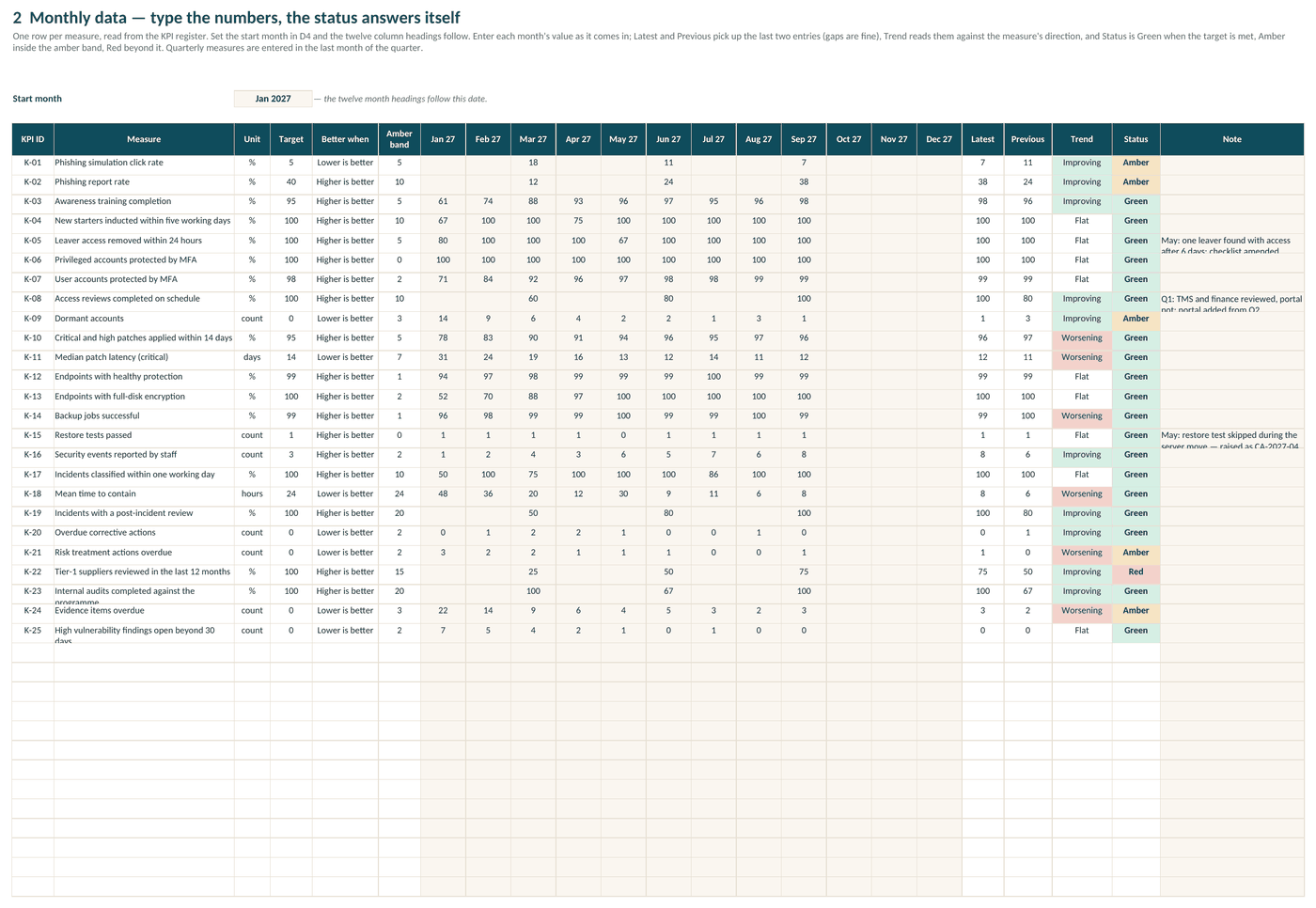
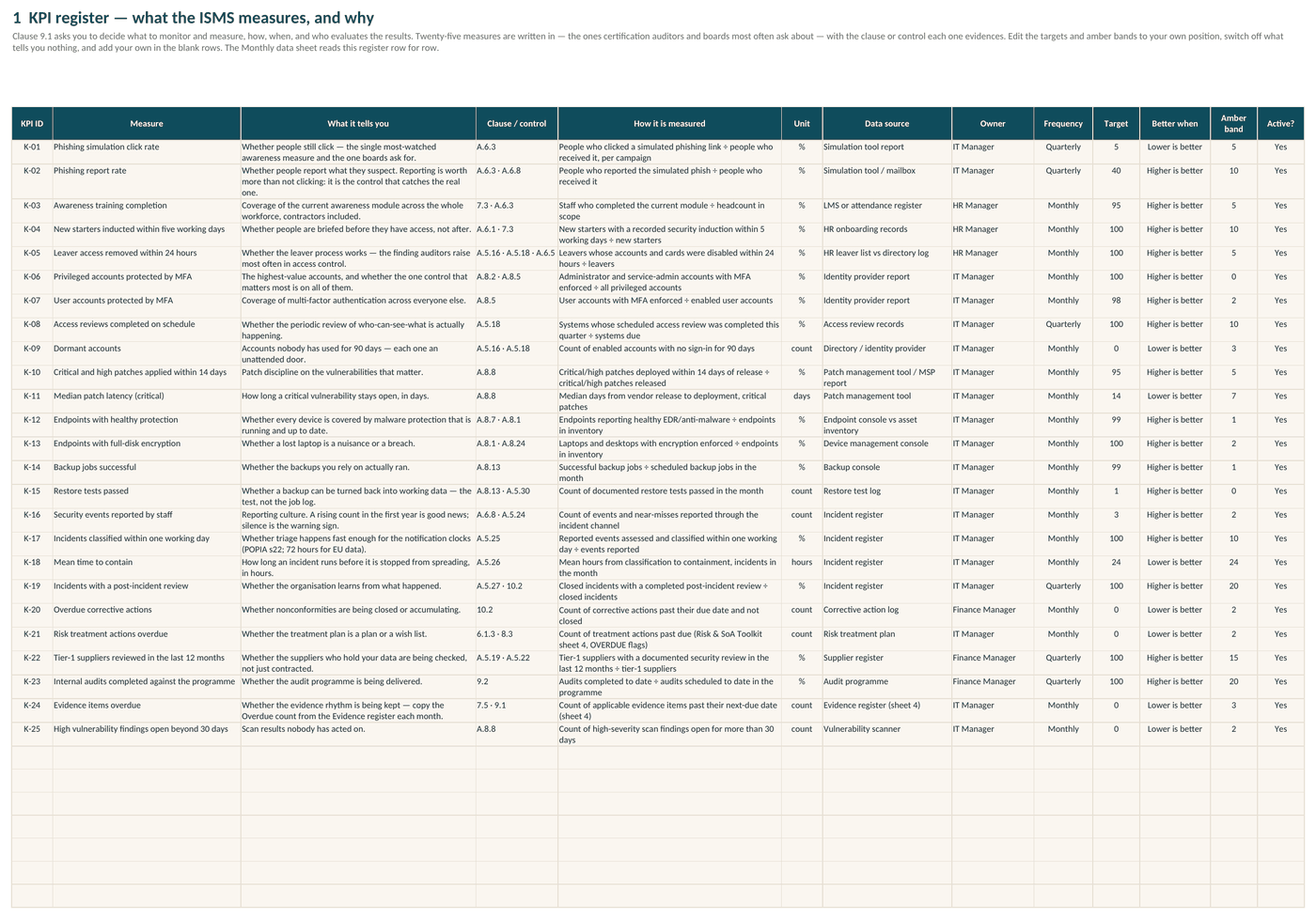
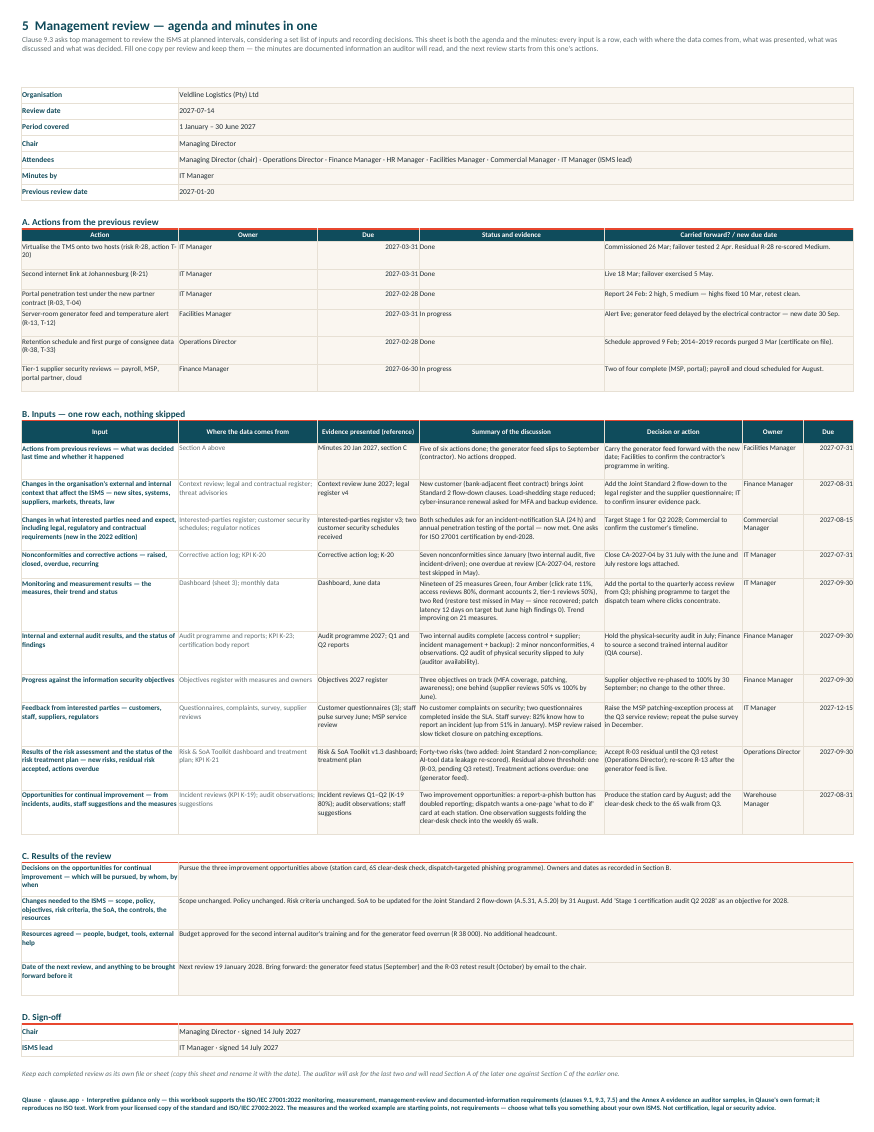
The three things an ISMS has to show after certification, in one workbook: measures with a live Green / Amber / Red status, management review minutes that cover every required input, and an evidence register that gives every control an owner, a rhythm and a due date.
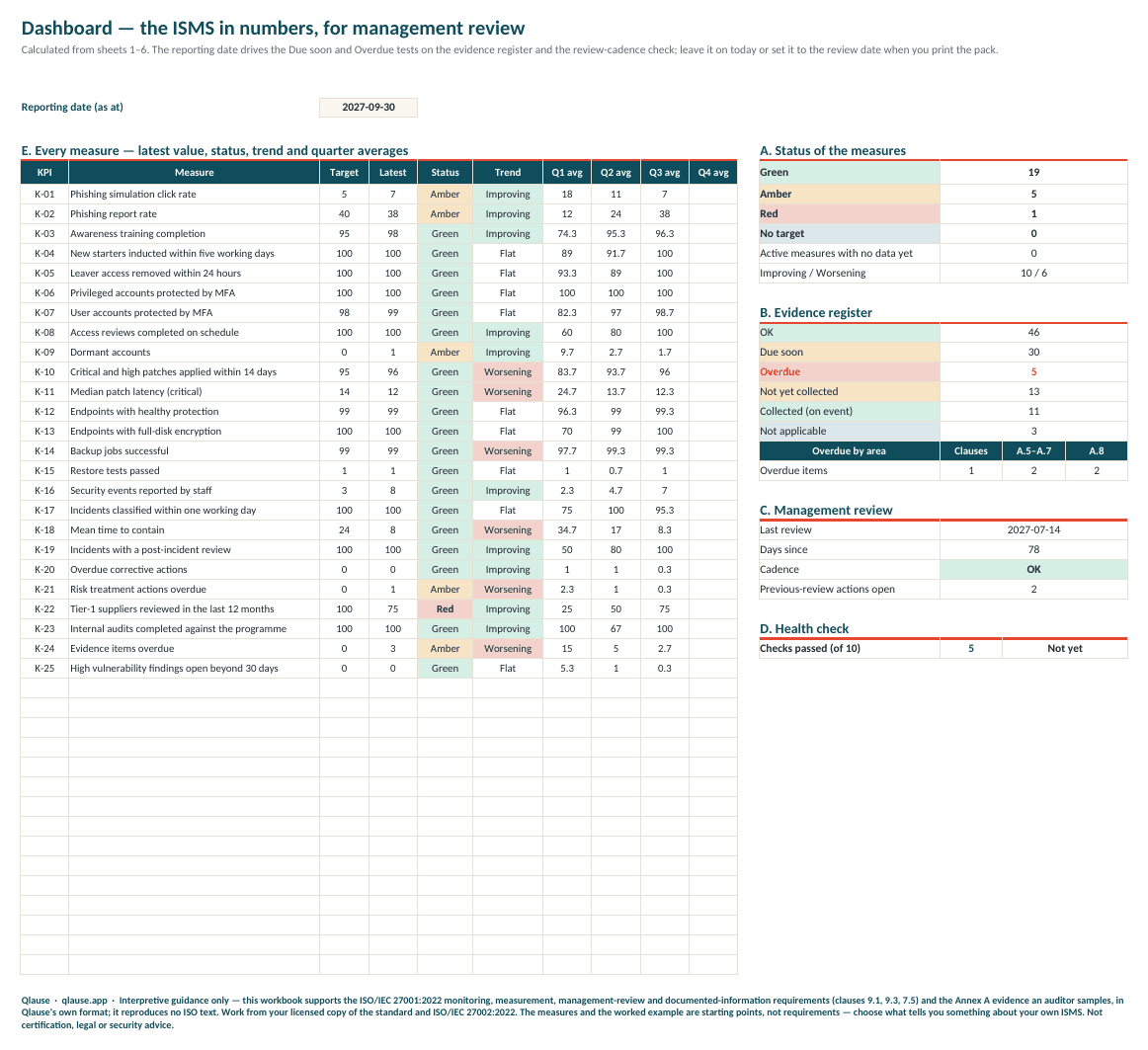
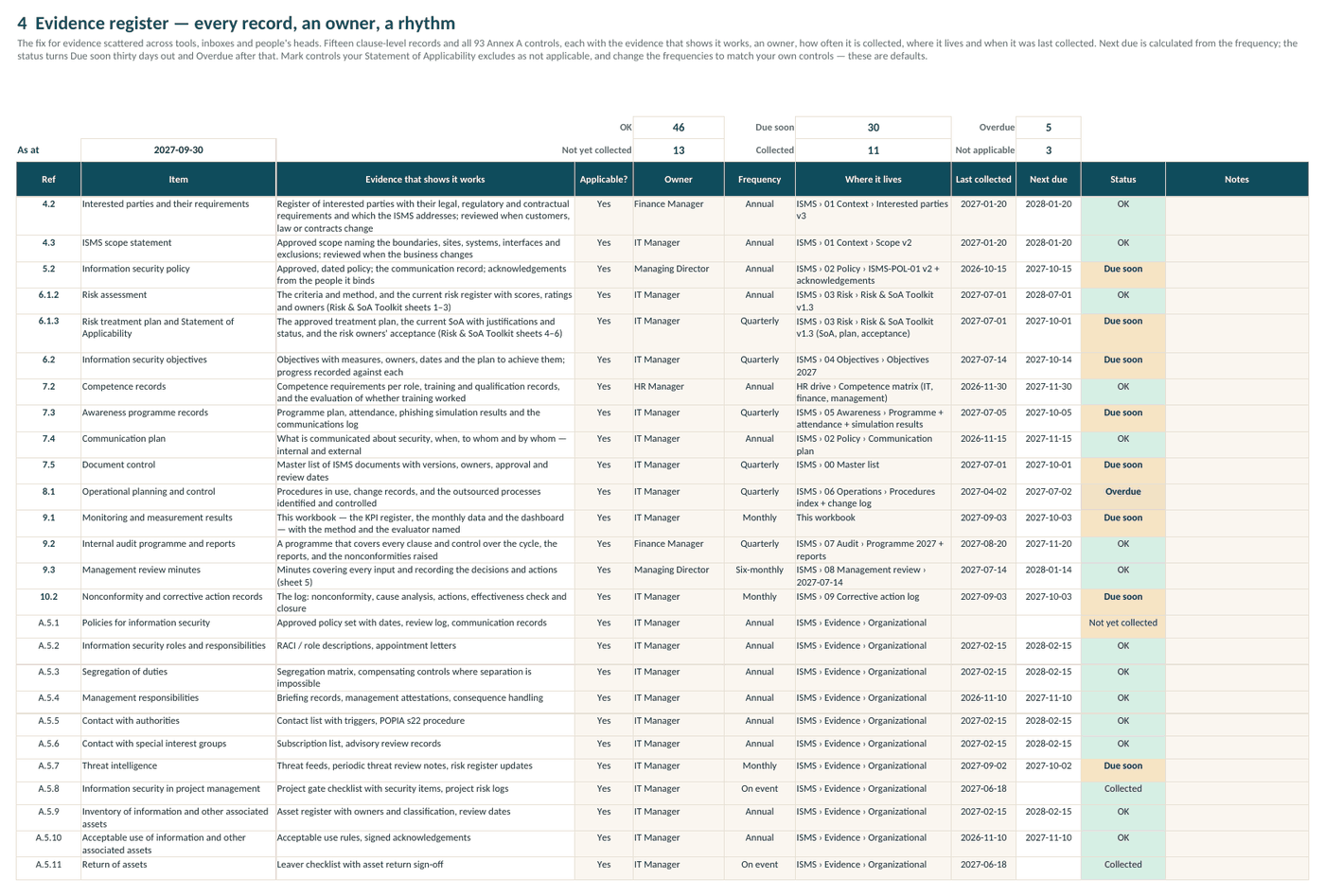
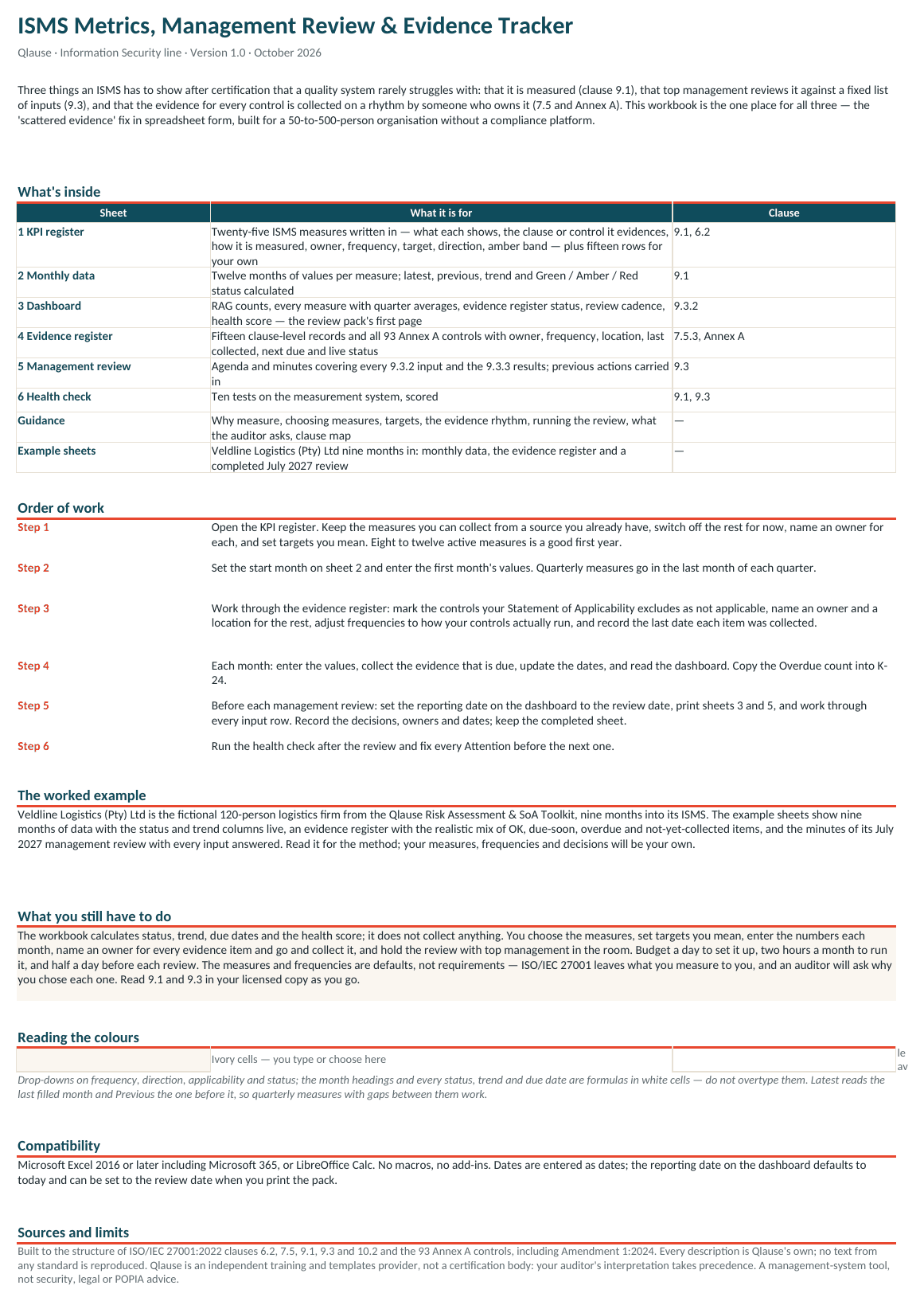
Real pages from the actual file — click any preview to enlarge.
- Twenty-five ISMS measures written in — phishing click and report rates, leaver access removed within 24 hours, MFA on privileged accounts, access reviews on schedule, patch latency, backup success and restore tests, events reported, time to contain, overdue corrective and treatment actions, supplier reviews, audits against the programme — each with what it tells you, the clause or control it evidences, method, source, target, direction and amber band
- Monthly data sheet: twelve months from a start date you set; Latest, Previous, Trend and Green / Amber / Red status calculated against the register (quarterly measures with gaps work)
- Dashboard built as the clause 9.3 input page — RAG counts, every measure with quarter averages, evidence register status, days since the last review, health score — with a reporting-date cell for printing the pack as at the review date
- Evidence register: fifteen clause-level records plus all 93 Annex A controls, each with the evidence that shows it works, applicability, owner, collection frequency, where it lives, last collected, a calculated next-due date and a live OK / Due soon / Overdue / Not yet collected status
- Management review template that is agenda and minutes in one: every 9.3.2 input as a row with its data source, the previous review's actions carried in, the results section and the sign-off
- Ten-point health check scored out of ten, a guidance sheet on choosing measures and running the review, and three worked-example sheets on the same fictional firm as the Risk Assessment & SoA Toolkit, nine months in
What you still have to do
The workbook calculates status, trend, due dates and the health score; it collects nothing. You choose the measures (eight to twelve is a good first year), set targets you mean, enter the numbers each month, name an owner for every evidence item and collect it, and hold the review with top management in the room. Budget a day to set it up, two hours a month to run it and half a day before each review. The measures and collection frequencies are defaults, not requirements — ISO/IEC 27001 leaves what you measure to you — written in our own words; you need your own licensed copy of the standard.
For: ISMS leads, quality and compliance managers and IT managers running an ISO/IEC 27001:2022 system between audits — and anyone preparing a first management review who would rather walk in with a dashboard than a slide.
Information Security Incident & Breach Response Kit (Excel + Word) — the register, the POPIA s22 decision, the Regulator pack, the notices and two tabletop exercises
When something happens the questions arrive faster than the facts: is it an incident, how bad, is it a POPIA breach, who must be told and by when, what do we write, what do we keep. This kit answers them in order.
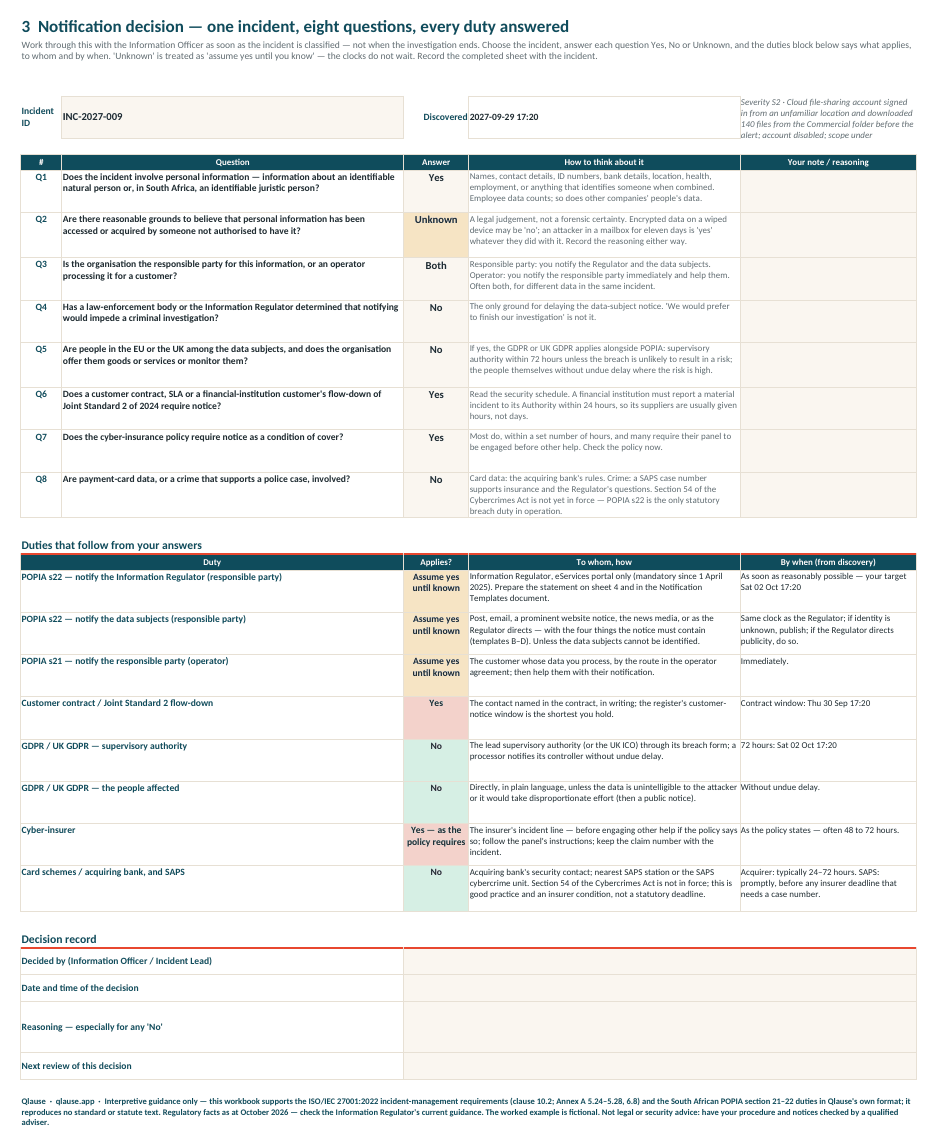
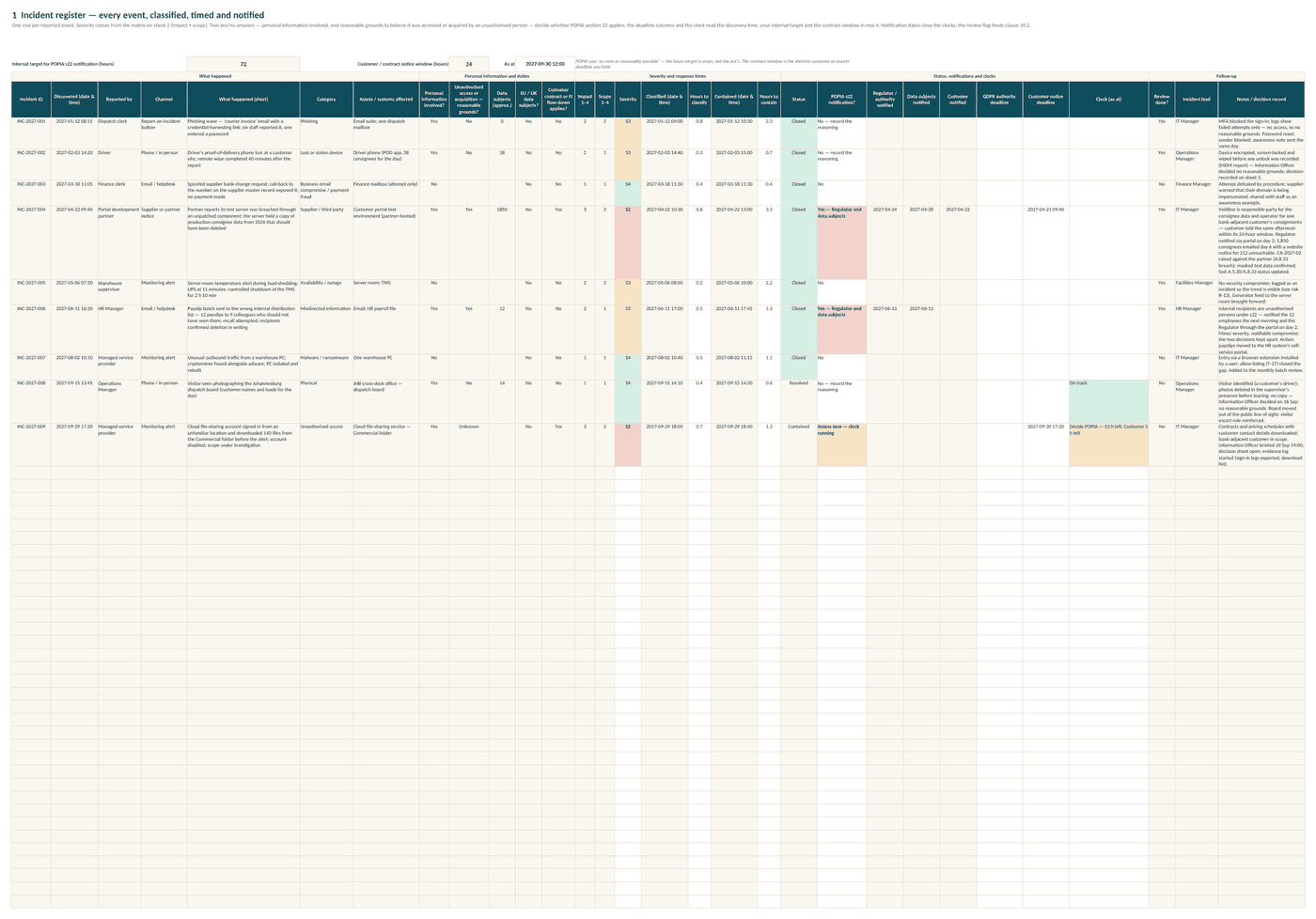
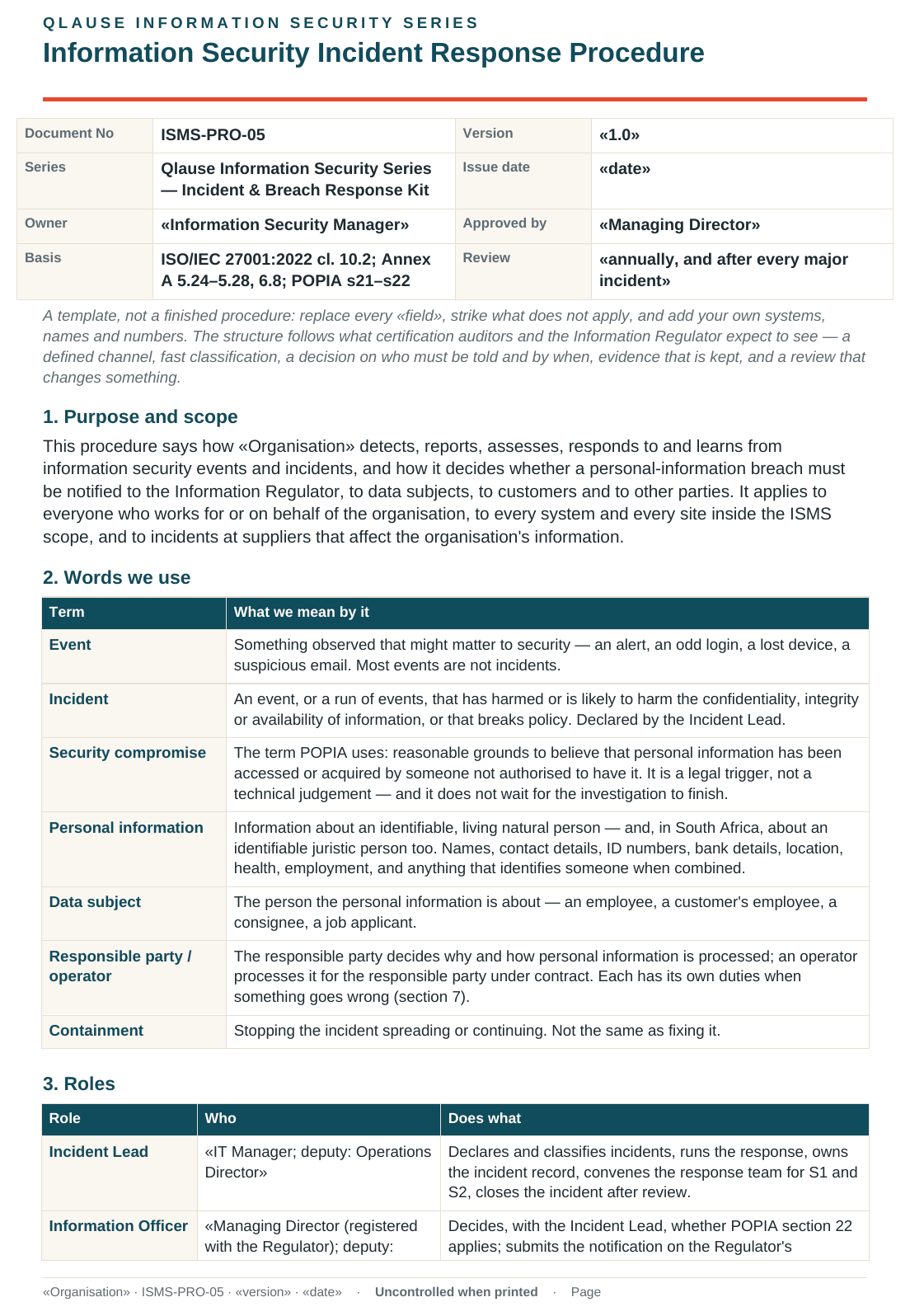
Real pages from the actual file — click any preview to enlarge.
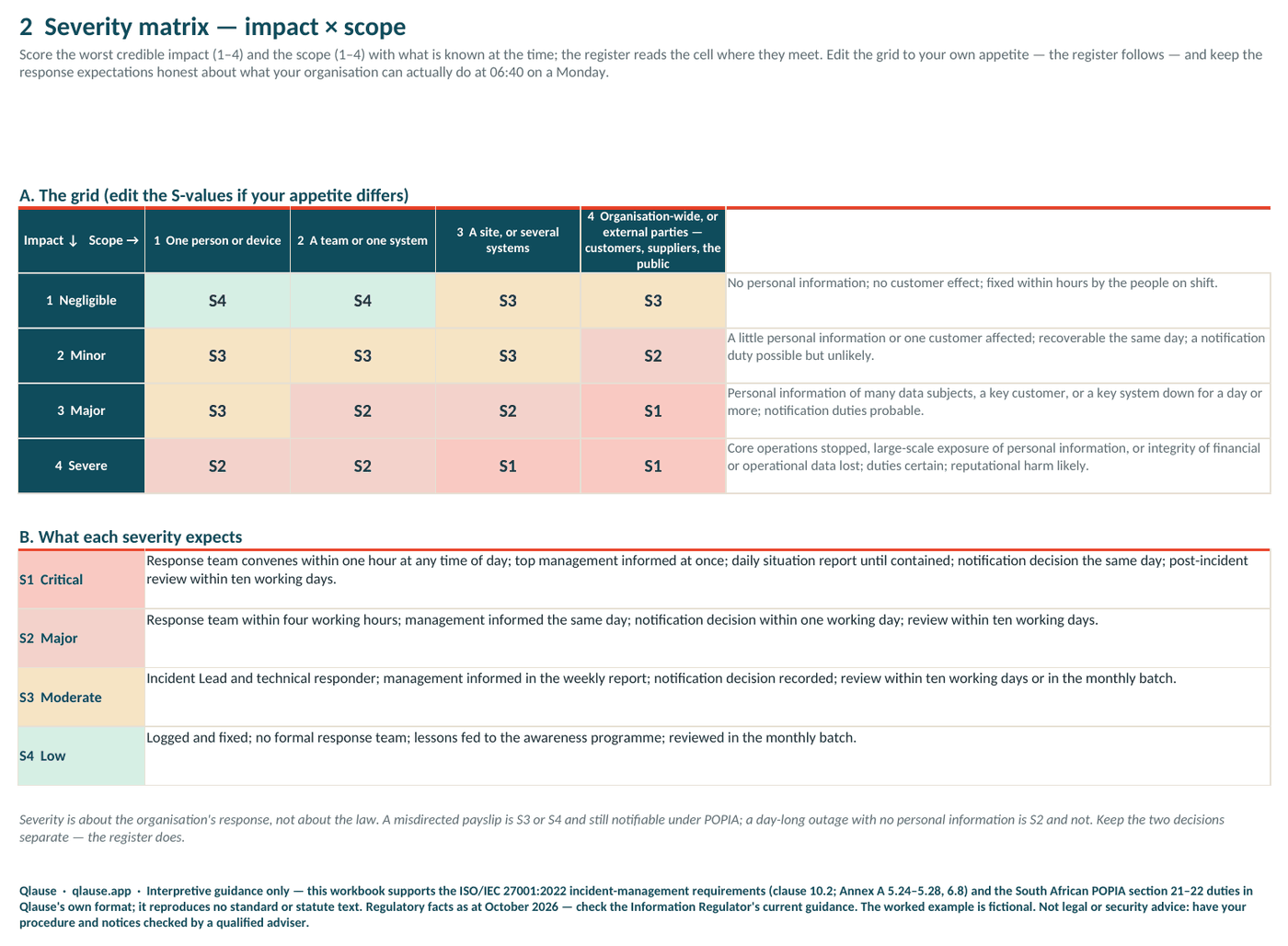
- Incident register that keeps the clocks: two yes/no answers decide whether POPIA section 22 applies and the register says so in words; severity from an editable impact × scope matrix; hours to classify and contain; your own notification target, the GDPR's 72 hours and the shortest customer or insurer window all run in a live clock column
- Notification decision for one incident — eight questions, every duty answered: applies or not, to whom, by when, with the deadline calculated from the discovery time; 'Unknown' is treated as 'assume yes until you know'
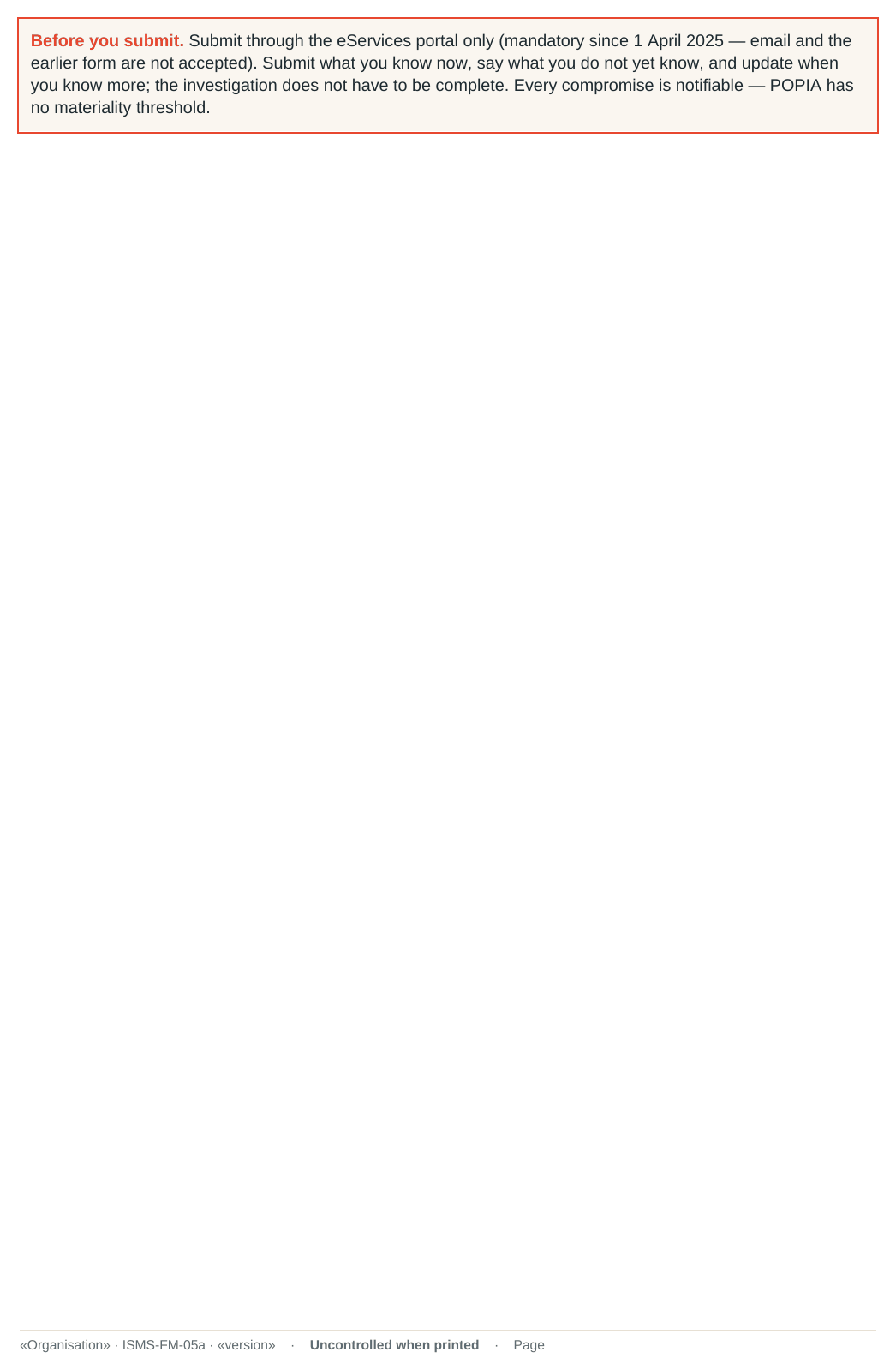
- The pack for the Information Regulator's eServices portal (mandatory since 1 April 2025) — thirteen things to have ready, the data-subject method choice under s22(4), and the notification timeline — plus a Word document of notification templates: the portal statement, an email, a letter and a website notice carrying the four things s22(5) requires
- ISMS-PRO-05 Incident Response Procedure (Word, template): roles, the reporting channel, triage and severity, containment to recovery, who must be told and by when — POPIA s21 and s22, contracts and Joint Standard 2, GDPR, insurer, card schemes, SAPS, with the Cybercrimes Act s54 position stated correctly — evidence, review, records, testing and a contact card
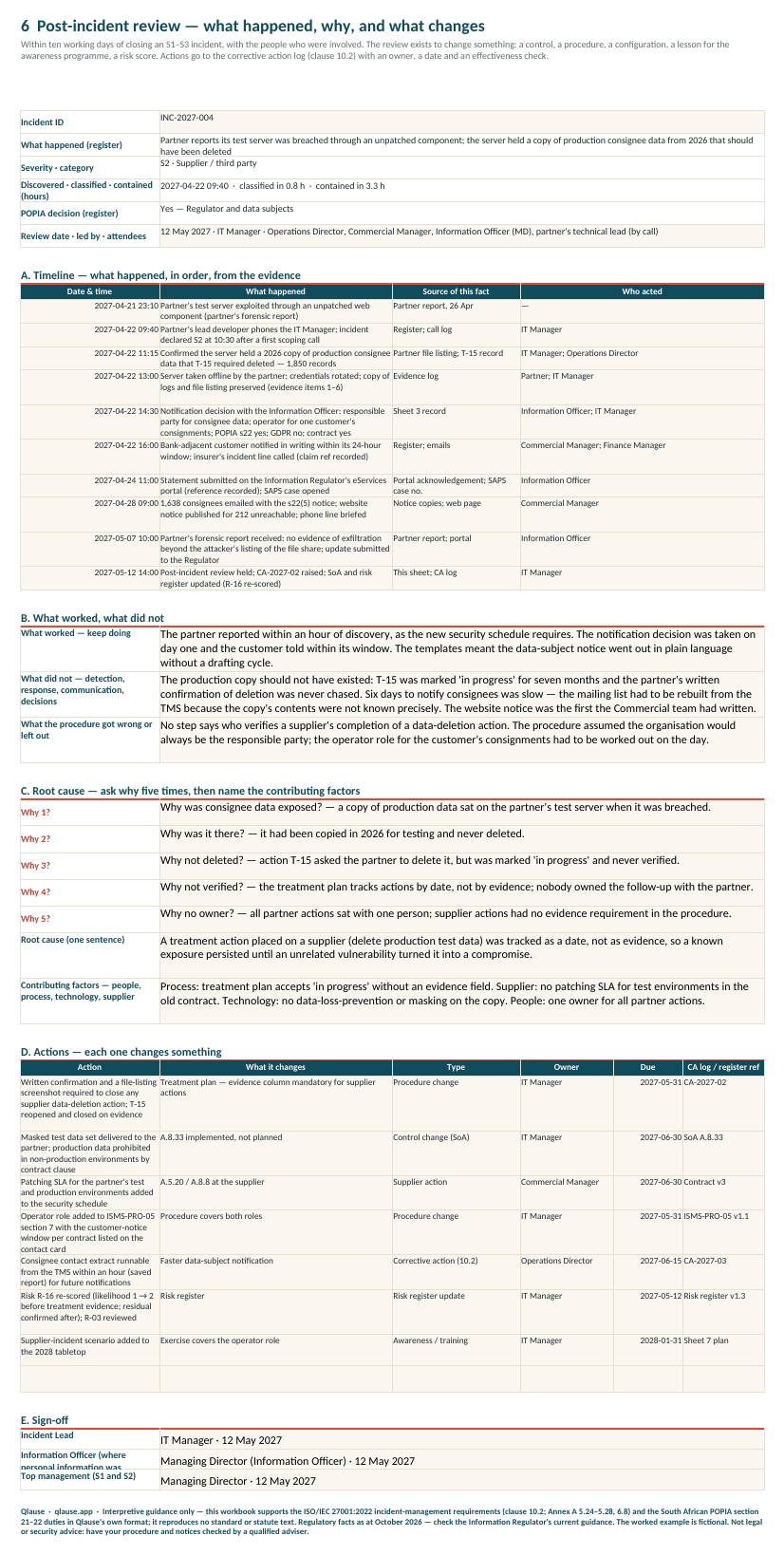
- Evidence log (chain of custody), a post-incident review that walks timeline → five whys → root cause → actions feeding clause 10.2, and a tabletop record with a ten-point observer checklist, scored
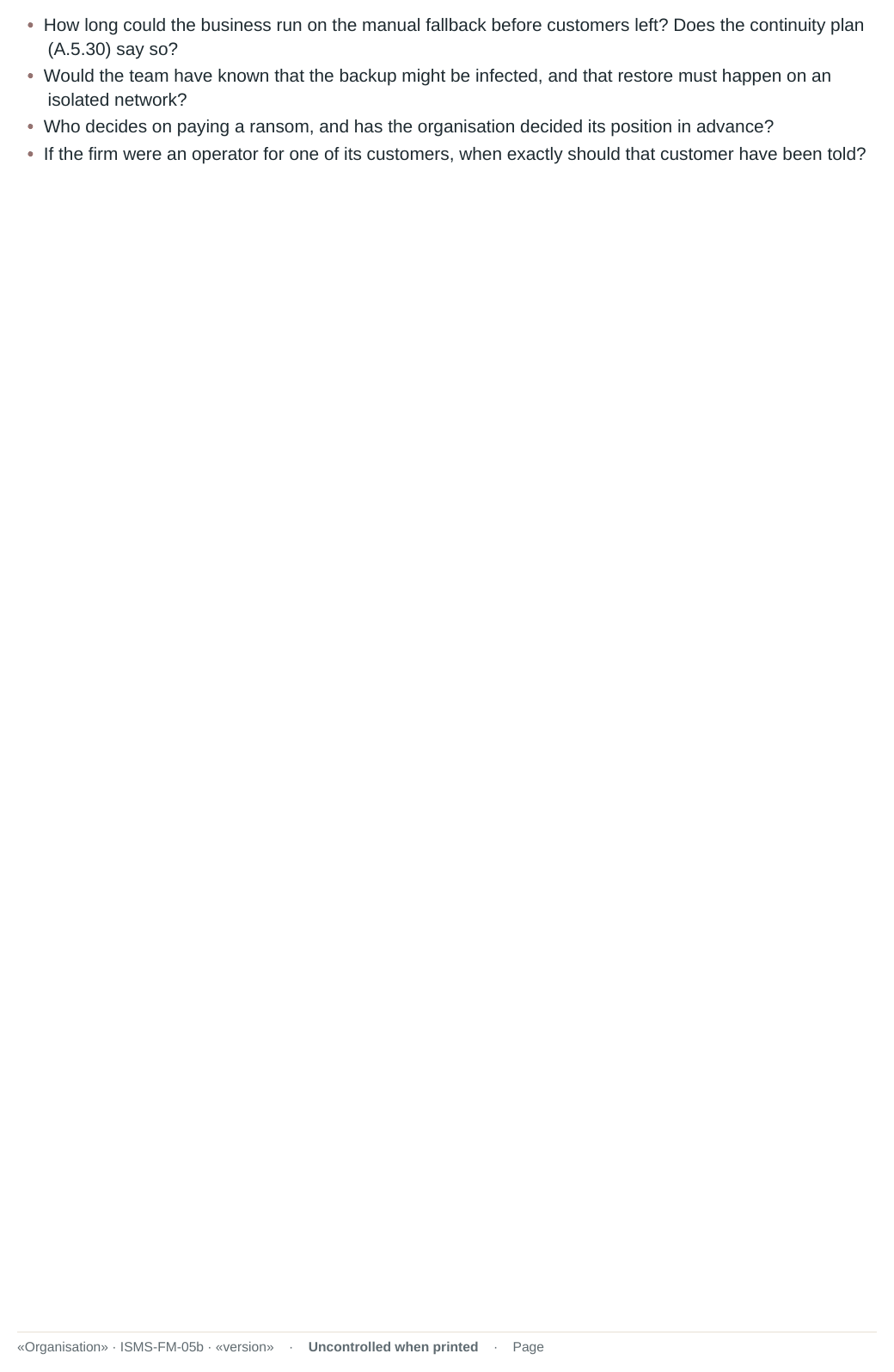
- Two 90-minute tabletop exercise scripts (Word) — ransomware on the operational server, and a business email compromise with a diverted payment — six timed injects each, what a good response includes, discussion questions and a debrief record; and a worked example of nine incidents on the same fictional firm as the other Qlause ISO 27001 tools
What you still have to do
The kit is the structure and the questions; the judgement is yours. You name the people, set your internal notification target (POPIA says 'as soon as reasonably possible' and gives no hours), adapt the severity grid and, on the day, make the reasonable-grounds call with your Information Officer and write the notice in your own voice from the template. Nothing in it is legal advice: have the procedure and the notice wording checked by a qualified adviser, and check the Information Regulator's current guidance — the regulatory facts are as at October 2026. Written in our own words; no standard or statute text is reproduced.
For: Information Officers, ISMS leads, IT managers and quality or compliance managers in South African organisations running or building an ISO/IEC 27001 system — and anyone who has just been told 'you are the Information Officer now'.
ISO 9001:2026 Transition Toolkit
Turn the 2026 changes into a working plan: gap checklist, clause-by-clause guidance and an action plan you can put in front of management.

Real pages from the actual file — click any preview to enlarge.
- 31-point gap checklist across every change area — climate context, quality culture & ethics, the risk/opportunity split (6.1.1–6.1.3), planning of changes (6.3), management review, the clause 10 renumbering and Annex A
- Clause-by-clause guidance in plain English — 13 areas, mapped to what auditors will actually look for
- A 14-step action plan phased to the Global ACI milestones — now, year 1, year 2 and buffer — ending 30 September 2029
- Version 2.0, checked line by line against the published text on 27 September 2026 — free to every earlier buyer as a Payhip product update
For: Quality managers and consultants planning the move from ISO 9001:2015.
ISO 14001:2026 Transition Toolkit
Move your environmental system from ISO 14001:2015 to the new 2026 edition: a clause-mapped gap checklist, plain-English guidance and the updated registers you'll actually need.


Real pages from the actual file — click any preview to enlarge.
- 18-point gap checklist covering every change — climate & broader context, the new change-planning clause (6.3), the risk/opportunity split and the life-cycle view
- Clause-by-clause guidance in plain English, mapped to what auditors will look for
- A phased action plan structured around the 3-year clock (the transition ends on 30 April 2029)
- Updated registers built in — Context & Interested Parties, Risk & Opportunity, and a life-cycle Environmental Aspects register
For: EHS and quality managers and consultants planning the move from ISO 14001:2015.
8D Problem-Solving Toolkit (Excel)
The full 8D method in one working workbook: a D0–D8 report with Is/Is-Not, the three-legged 5-Why and an Ishikawa canvas built in — you fill the fields, not the theory.


Real pages from the actual file — click any preview to enlarge.
- Complete D0–D8 8D report with a live progress tracker across all nine disciplines
- Three-legged root cause analysis — occurrence, detection (escape point) and systemic — the way customers and auditors expect it
- Built-in supporting tools: Is/Is-Not analysis, a 3-legged 5-Why, and an Ishikawa (fishbone) canvas with a cause-evaluation table
- Prevent-recurrence and read-across sections (PFMEA, control plan, lessons learned) so the fix sticks across every line and plant
For: Quality, engineering and operations teams answering customer complaints, recurring defects and formal 8D requests.
PFMEA Toolkit (Excel) — AIAG-VDA 7 steps
Process FMEA to the current method: type S, O and D and the Action Priority letter answers itself, colour-coded — with a linked process flow tab and the control plan handoff built in.


Real pages from the actual file — click any preview to enlarge.
- Full 7-step PFMEA sheet: structure, function and failure analysis, separate prevention and detection controls, and an optimization block with owners, dates, status and re-rated AP (prints on A3)
- Action Priority calculated live from the complete S-O-D logic — on current ratings and again after optimization; High and Medium lines colour themselves
- Linked process flow tab — enter your operations once and the PFMEA picks them from a drop-down, so the two documents cannot drift apart
- 13-line worked example on the same welded bracket as the free Control Plan Template — including a High closed to Low by error-proofing, and a Medium closed by documented justification
- Control plan handoff tab mapping every special characteristic and detection control to control plan columns, plus plain-language S/O/D rating guidance
What you still have to do
The worked example is a teaching model — your PFMEA is only valid built by your own cross-functional team against your own process, rated against your licensed AIAG & VDA FMEA Handbook and your customer-specific requirements. This workbook reproduces no handbook text, forms or tables.
For: Quality, manufacturing and process engineers building or updating PFMEAs — and any manufacturer analysing process risk properly.
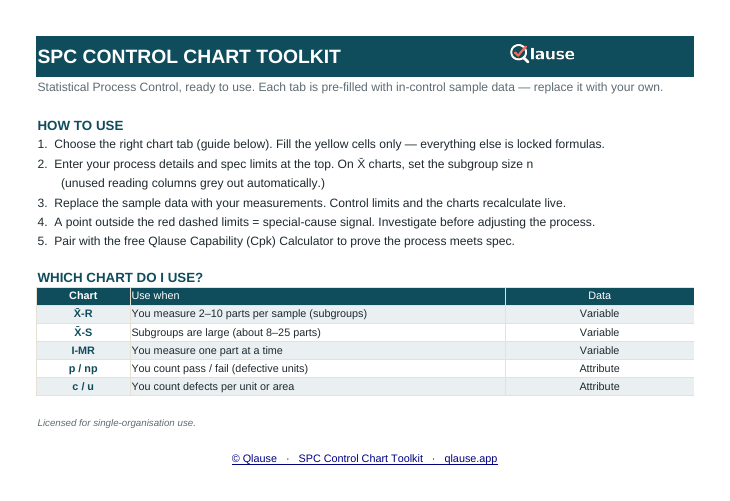
SPC Control Chart Toolkit (Excel)
Pick the right tab, fill the yellow cells, and watch control limits and charts calculate live — no SPC maths, no macros, no setup.
Real pages from the actual file — click any preview to enlarge.
- X̄-R, X̄-S and I-MR charts for variable data, plus switchable p/np/c/u attribute charts
- Control limits (UCL / centre line / LCL) calculate automatically as you enter data
- Start-Here guide: which chart to use and how to read the signals
- Spec fields (USL / LSL / target) and present-ready formatting — plain Excel, no add-ins
For: Quality engineers running ongoing process control and customer submissions.
Free downloads
HACCP Flow Diagram & Product Description Template (Excel)
The first five steps of a HACCP study — the two documents every hazard you find later is built on, and the two where more studies go wrong than anywhere else.


Real pages from the actual file — click any preview to enlarge.
- Product description and intended use with a note on every field saying what belongs there and why it matters later — including the two intended-use fields that decide half your severity ratings
- Process flow with inputs, outputs, safety parameters and hygiene zone per step, plus the on-site confirmation block for Codex step 5 — the requirement most sites treat as a formality
- Worked example on a cooked sliced ready-to-eat chicken breast: full description and a fifteen-step flow including the storage, zone transfer and despatch legs most diagrams leave out
- 12-point health check with a live score for the flow diagram and product description you already have
For: Food safety and quality teams starting or rebuilding a HACCP study — and anyone whose flow diagram has never been walked and signed.
FSSC 22000 V7 Gap Checklist (Excel)
Every change from FSSC 22000 Version 6 to Version 7 as a tracked project — V6 audits end on 30 April 2027, and this is the file that gets a site to its upgrade audit with the evidence ready.


Real pages from the actual file — click any preview to enlarge.
- 27 lines — the ISO 22002-x:2025 framework change, every Part 2 clause 2.5.1–2.5.18 and the audit-process changes — each with the V6 position, what changed in V7, the evidence the auditor will ask for and a priority
- Status drop-downs, owners, target dates, overdue flags and a summary tab with a self-calculating readiness score and open items by priority
- Timeline tab with the eight dated milestones and days-to-go from today, plus a sources tab pointing at the free scheme documents
For: Food safety and quality managers at FSSC 22000 certified sites planning the V7 upgrade audit — and anyone implementing FSSC 22000 for the first time against Version 7.
ISO/IEC 27001:2022 Gap Analysis Checklist (Excel)
Where you stand against ISO/IEC 27001:2022 in one afternoon — the 30 management-system requirements and all 93 Annex A controls, scored, with owners, dates and a readiness figure that calculates itself.
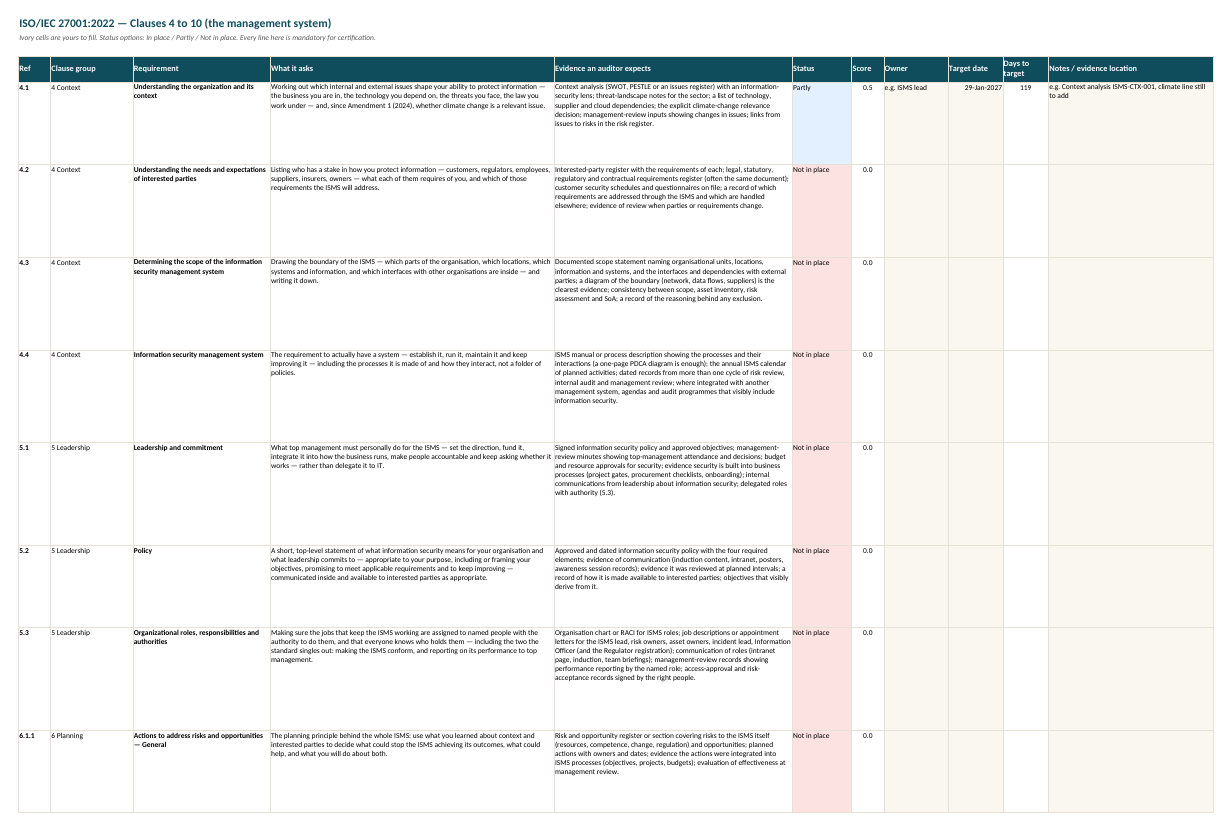
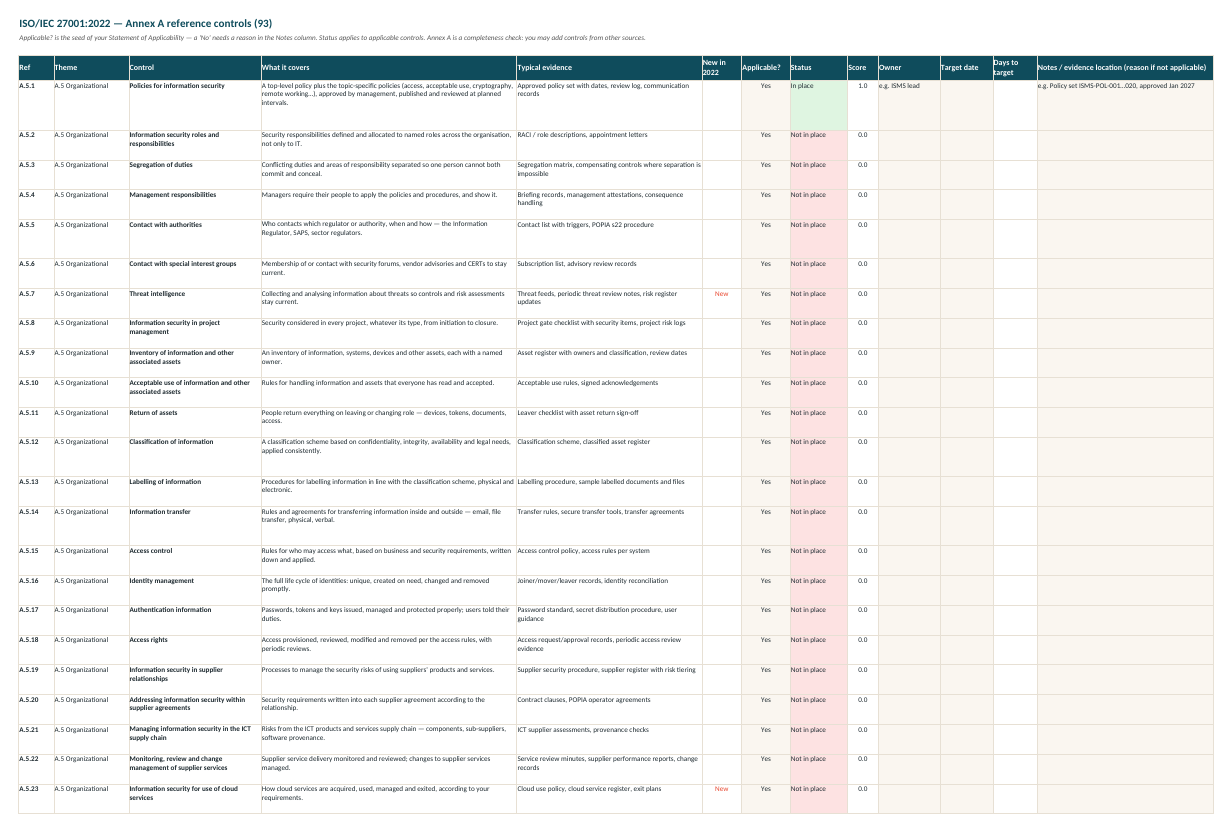
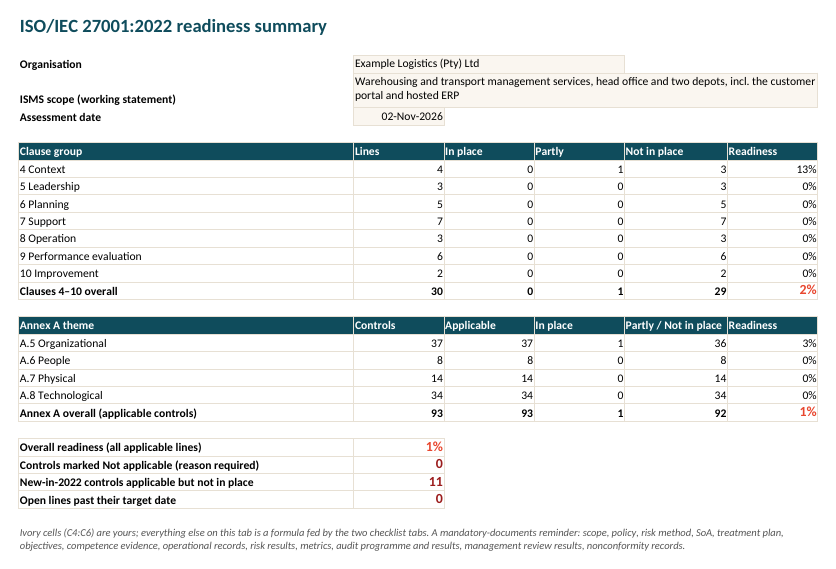
Real pages from the actual file — click any preview to enlarge.
- 123 lines — every clause 4–10 requirement and every Annex A control, each with what it asks in plain English and the evidence an auditor expects; the 11 controls new in 2022 flagged
- An Applicable? column on the Annex A tab seeds your Statement of Applicability; status drop-downs score In place / Partly / Not in place, with owners, target dates and overdue flags
- Summary tab with readiness by clause group and by Annex A theme, open items and new-in-2022 gaps, plus a 44-week timeline to Stage 2 that recalculates from your start date
For: Quality, IT and compliance managers starting an ISO 27001 implementation — especially those adding information security to an ISO 9001 system they already run — and anyone health-checking an existing ISMS before an audit.
POPIA ↔ ISO/IEC 27001 Crosswalk (Excel)
Twenty-four POPIA and Regulation 4 duties in plain words, each mapped to the ISO/IEC 27001:2022 clauses and Annex A controls that evidence it — with the GDPR article and NIST CSF 2.0 category alongside, the evidence to show, and a status you mark.
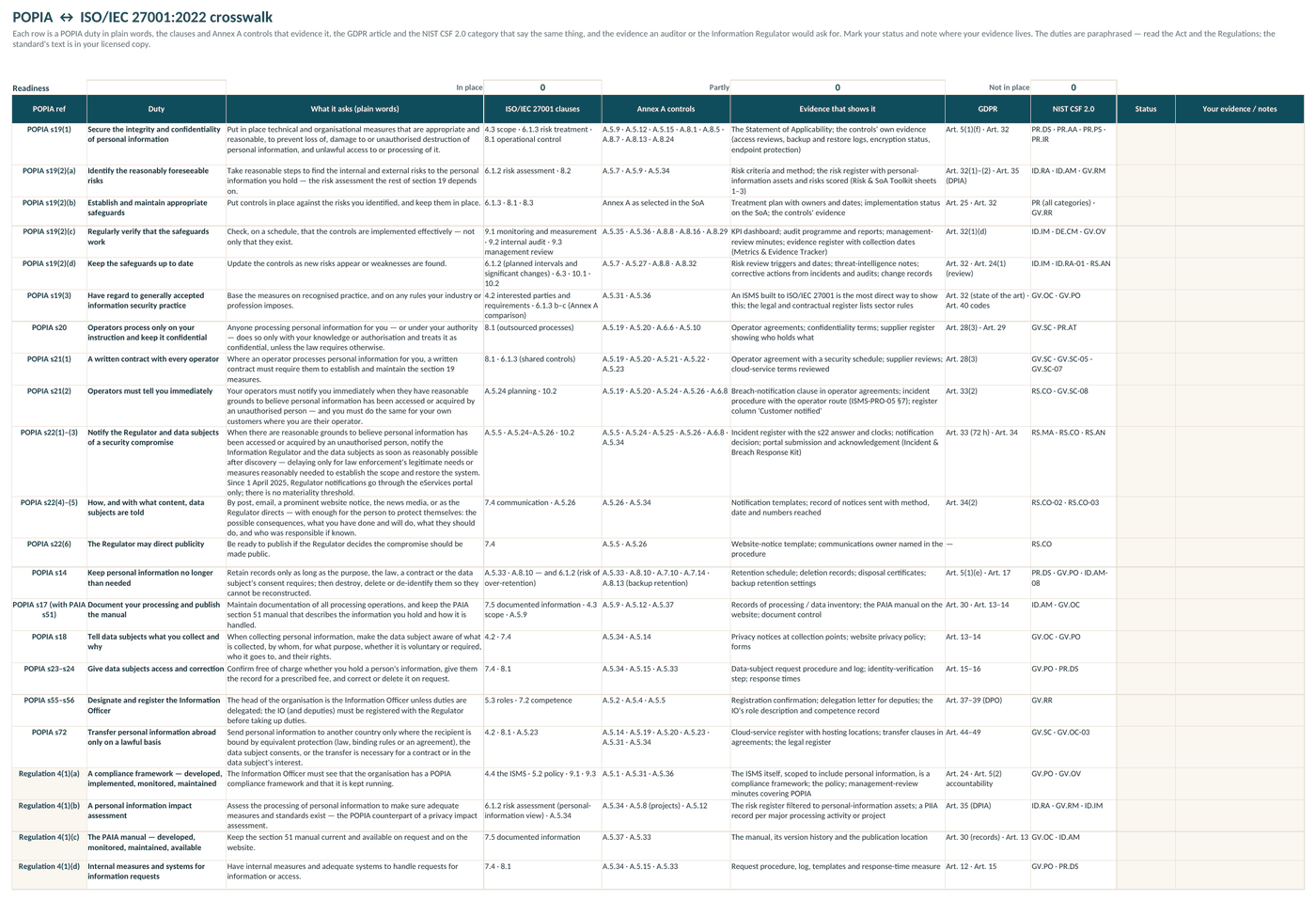
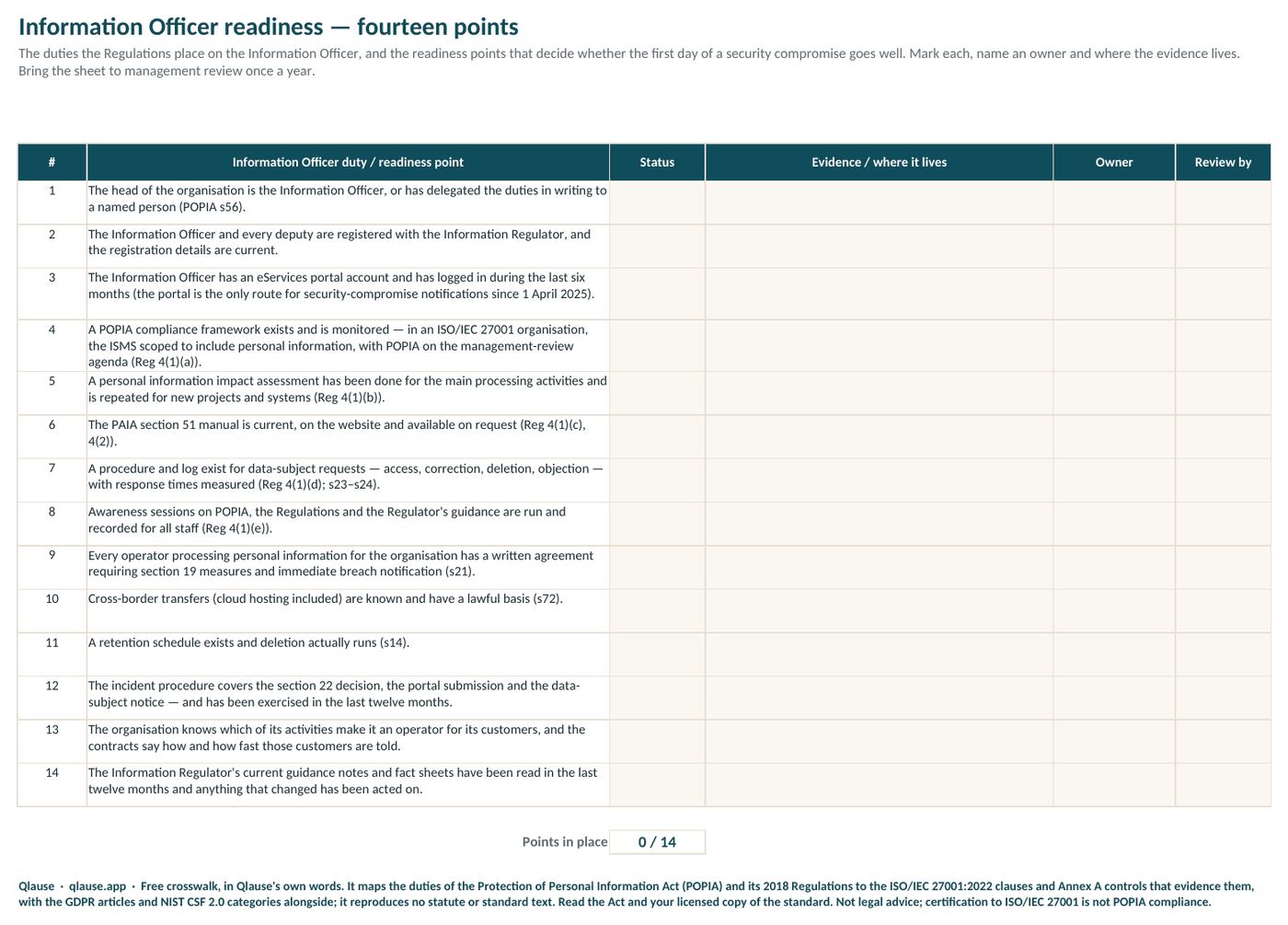
Real pages from the actual file — click any preview to enlarge.
- Sections 14, 17, 18, 19, 20, 21, 22, 23–24, 55–56 and 72 and Regulation 4(1)(a)–(e) and 4(2), paraphrased for a management-system reader, with the evidence the Information Regulator or an auditor would ask for
- Status per duty (In place / Partly / Not in place / Not applicable) with a readiness percentage at the top; GDPR and NIST CSF 2.0 columns for the customers who ask in those languages
- An Information Officer readiness sheet — fourteen points from the Regulations and from the first day of a breach: registration, the eServices portal account, the exercised procedure
For: Information Officers and ISMS leads in South African organisations who need to answer 'are we compliant?' and 'are we certifiable?' from one set of records — and anyone explaining to a board why ISO 27001 is not a POPIA certificate.
Information Security Policy — one-page template (Word)
The clause 5.2 policy on one page: what you commit to, the objectives framework, who does what, the rules in brief, communication and review — with «fields» to fill and a box on how to keep it true.
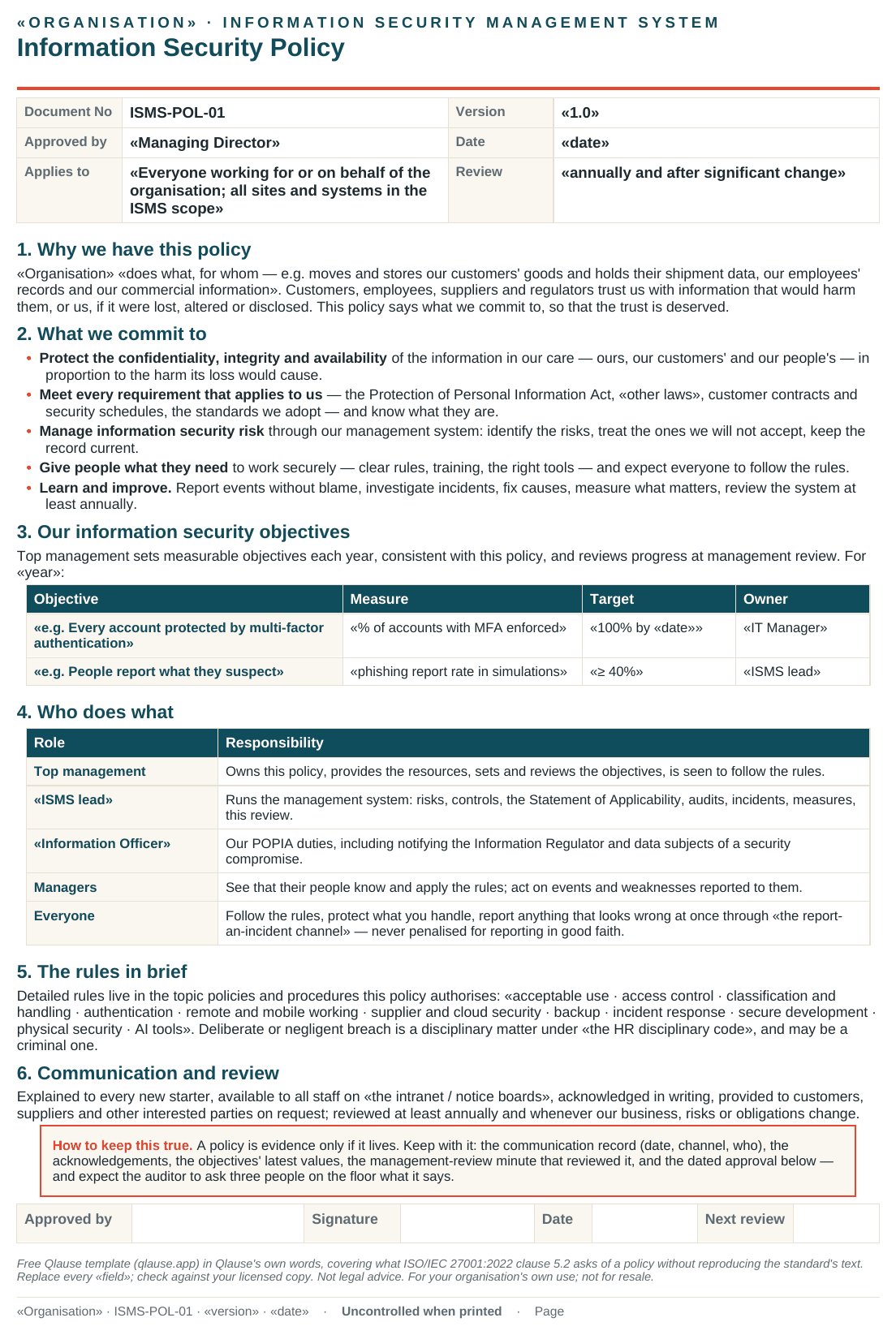
Real pages from the actual file — click any preview to enlarge.
- Covers what the standard asks of a policy — fit to purpose, the framework for objectives, the commitment to applicable requirements and to continual improvement, availability and communication — in plain words, without reproducing the standard's text
- Roles table that names the Information Officer and the POPIA duty alongside the ISMS lead, managers and everyone; a rules-in-brief line that authorises the topic policies
- 'How to keep this true' — the evidence an auditor wants beside the signature: the communication record, acknowledgements, the objectives' latest values, the management-review minute
For: Anyone writing the first ISMS policy, or replacing a three-page one nobody reads — ISMS leads, quality managers adding information security to an existing system, IT managers handed the job.
ISO/IEC 27001:2022 Annex A — 93 Controls Quick Reference (A3 PDF)
One A3 page: all 93 Annex A controls in their four themes, the eleven new in 2022 flagged, and the ISO/IEC 27002:2022 attribute legend — the poster for the wall beside the Statement of Applicability.
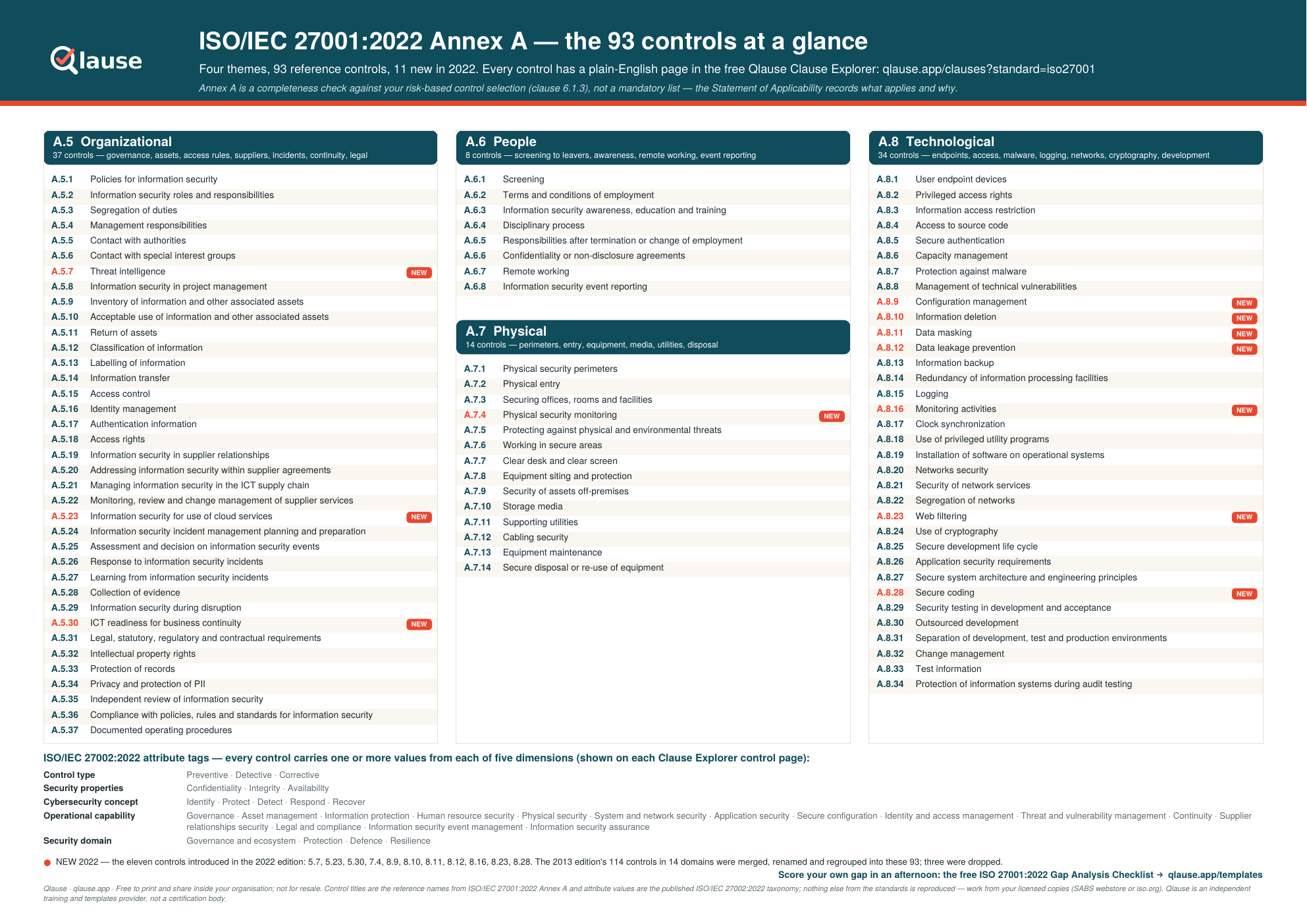
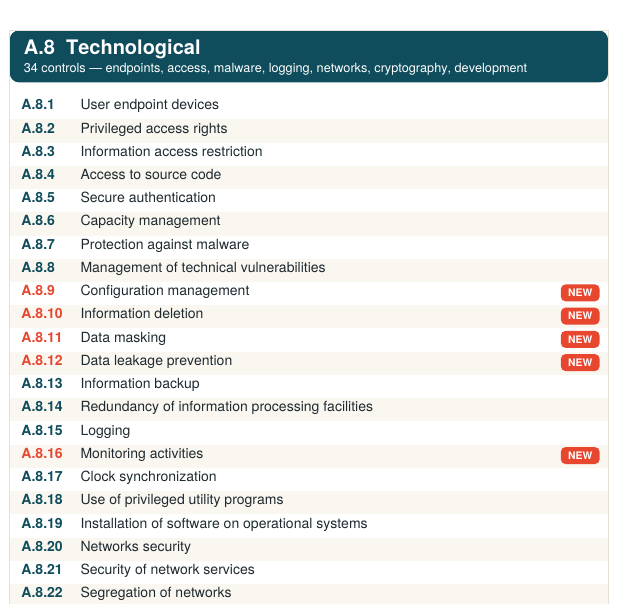
Real pages from the actual file — click any preview to enlarge.
- A.5 Organizational (37), A.6 People (8), A.7 Physical (14) and A.8 Technological (34) — every control number and reference title at a glance, print-ready at A3
- The eleven controls new in the 2022 edition marked, with the 114-to-93 restructuring explained in a line
- The five ISO/IEC 27002:2022 attribute dimensions and their values, so the tags on each Clause Explorer control page read at a glance
For: Anyone building or auditing an ISMS who wants the whole of Annex A on one page — ISMS leads, internal auditors, IT managers, and quality managers adding information security to an existing system.
Process Flow Template (Excel)
The first document of the core-tools chain — every step the part actually takes, including the storage, transport and rework loops the control plan never shows.


Real pages from the actual file — click any preview to enlarge.
- Blank process flow with step-type symbols (operation, inspection, transport, storage, delay) and a feeds-PFMEA / control-plan column for the shared operation numbering
- Worked example on the same welded bracket as the Control Plan Template — including the rework loop with its written re-entry rule
- 10-point health check with a live score for the flows you already have
For: Quality and manufacturing engineers starting a PFMEA or control plan — and anyone whose current flow diagram only shows the happy path.
Control Plan Template (Excel)
The production rulebook as a working file — a blank control plan, a filled worked example, and a 12-point health check for the plans you already have.


Real pages from the actual file — click any preview to enlarge.
- Blank control plan in the standard column set — copy it once per phase (prototype, pre-launch, production)
- Worked example written the way a good plan reads, including reaction plans that name the containment quantity
- 12-point health check with a live score, plus the containment-window calculator: rate × interval = the parts you sort when a check fails
For: Quality and manufacturing engineers writing or auditing control plans — and any manufacturer proving controlled conditions under ISO 9001 8.5.1.
MSA / Gage R&R Study Template (Excel)
Prove the gauge before you trust the number — a crossed Gage R&R worked by ANOVA and by average and range side by side, plus a type 1 gauge study, all as live formulas.
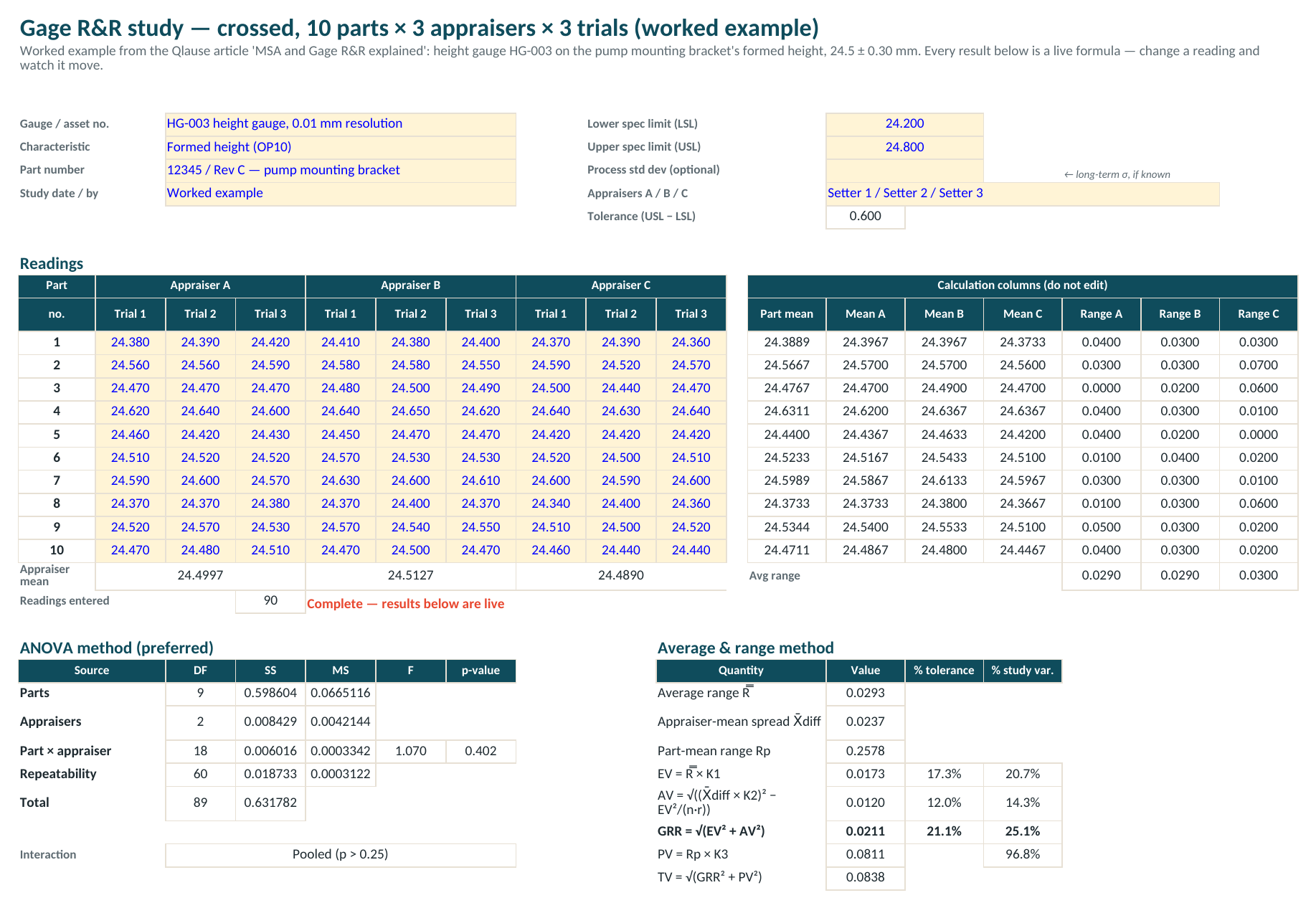
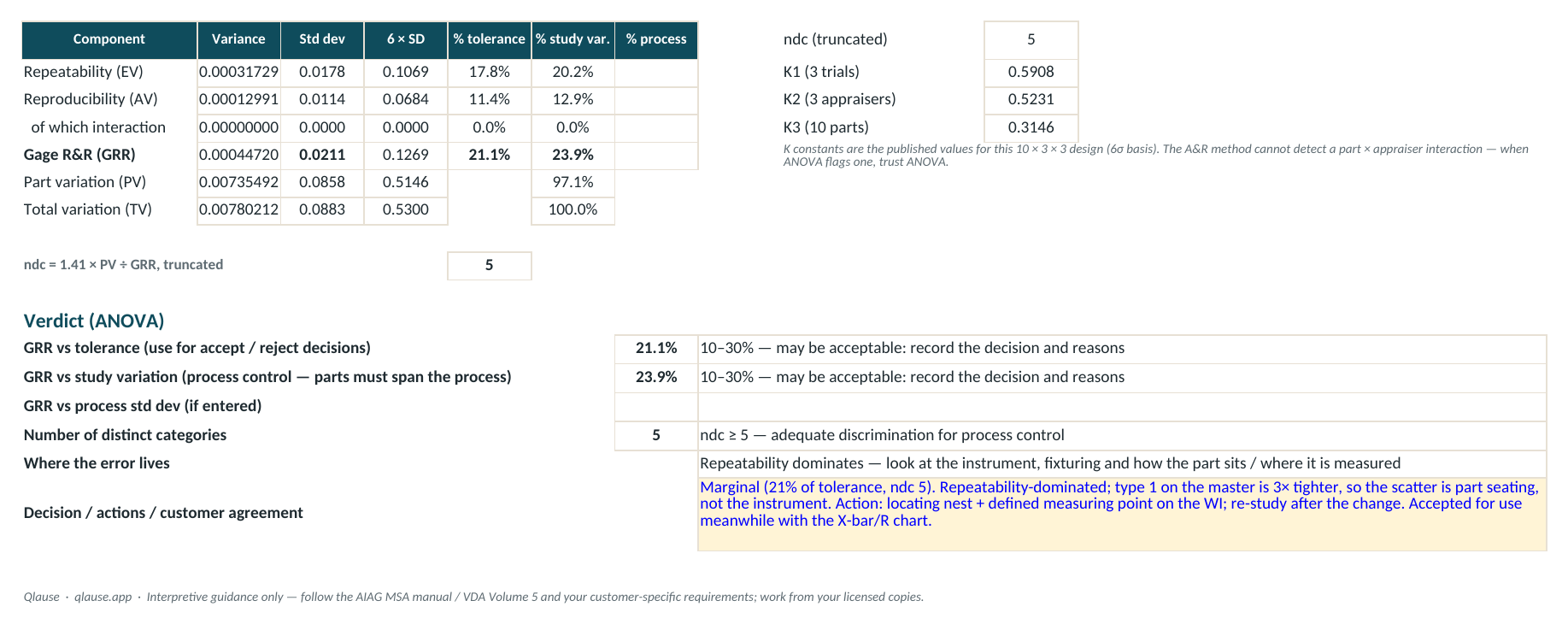
Real pages from the actual file — click any preview to enlarge.
- Crossed Gage R&R for 10 parts × 3 appraisers × 3 trials: ANOVA with the part × appraiser interaction test and the average & range method on the same readings
- %GRR against tolerance and against study variation, optional %process, ndc and a verdict against the 10% / 30% bands — with a box for the decision and the customer agreement
- Type 1 gauge study (bias, t-test, Cg, Cgk) and worked examples on the same pump mounting bracket as the Control Plan Template
For: Quality and metrology engineers running MSA for PPAP, IATF 16949 7.1.5.1.1 or a control plan — and anyone quoting a %GRR without saying what it is a percentage of.
Fast Response Tracker (Excel)
Log every open concern and drive it to closure — a live board that shows what's open, overdue, and which 8D step each issue is on.

Real pages from the actual file — click any preview to enlarge.
- One line per issue: owner, containment date, target close and status
- Live Total / Open / Closed / Overdue tiles at the top
- Tracks the 8D step (D0–D8) each concern is on — the natural companion to the 8D Toolkit
For: Anyone running a quality response board, layered process audits, or a fast-response meeting.
NC Writing Checklist (Excel)
Write audit nonconformities that hold: requirement, evidence, statement — in that order, checked before the finding is issued.
- A requirement / evidence / statement form that makes you quote the requirement instead of paraphrasing it
- A one-page pre-issue check for the finding before it goes to the auditee
- A worked example and a how-to-use sheet
For: Internal auditors and audit programme managers who want findings that survive the closing meeting.
Master Document Register (Excel)
The register at the centre of document control: every controlled document with its number, owner, current revision, status and next review date.
- Doc number, title, type, owner, current revision, status, effective date, next review and location for every controlled document
- Starter rows in the QM / QP / FM numbering scheme used across Qlause
For: Anyone setting up or cleaning up document control for ISO 9001.
ISO 14001:2026 Gap Analysis Checklist
See where your environmental system already meets the 2026 edition and where the gaps are — a clause-by-clause self-check in about 10 minutes.

Real pages from the actual file — click any preview to enlarge.
- 10-point self-check across every 2026 change area — climate, wider context, clause 6.3, life-cycle aspects and more
- Live readiness score and gap count as you fill it in
- The natural first step before the full Transition Toolkit
For: Anyone certified to ISO 14001:2015 wondering how big the move to 2026 is.
ISO 9001:2026 Readiness Scorecard
Score your culture, leadership, risk and context gaps against the 2026 changes in about 10 minutes.

Real pages from the actual file — click any preview to enlarge.
- Self-assessment across the 2026 change areas
- Instant download — see where you stand before you plan
For: Anyone certified to ISO 9001:2015 wondering how big the move is.
Capability Study (Cpk) Calculator
Paste your measurements, get Cp, Cpk and predicted yield instantly — prove the process is capable.

Real pages from the actual file — click any preview to enlarge.
- Cp, Cpk and predicted out-of-spec yield from your raw data
- Pairs with the SPC Toolkit for ongoing control
For: Quality engineers, PPAP submitters and auditors checking capability.
Constraint Finder (Excel)
The five focusing steps of the Theory of Constraints as a one-page worksheet — find the bottleneck, then protect its time.
- A yes/no diagnostic for where your constraint actually lives
- The five focusing steps, one block each, with space for the plan that protects the constraint's time
- A how-to-use sheet
For: Production and CI leads whose line is always busy and still late.
NC Writer Lite — free AI prompt for ISO 9001 findings
Turn rough internal-audit notes into an ISO 9001 nonconformity — requirement, evidence, statement — with a confidence level and the questions to close the gaps. Works in any AI chat.
- One plain-text prompt for Claude, ChatGPT, Microsoft Copilot or Gemini — paste it as your first message
- Write mode, ISO 9001 only: requirement → evidence → statement, a confidence level, and [CONFIRM] questions instead of invented facts
- A short PDF on how to use it, with a worked example
For: Internal auditors who want to try the AI Auditor Pack's method before they buy anything.
Free on-demand masterclasses
Short, plain-English video walkthroughs — HACCP Plan · ISO 9001:2026 · 8D Problem-Solving · Control Charts · Process Flow & PFMEA · FSSC 22000 V7 · ISO 27001. Watch free, then put the matching toolkit to work.

The book — The Clause Companion
The toolkits give you the documents. The book explains the whole standard in plain language — mirror-numbered so Chapter 8 is clause 8, with the same six treatments for every clause family, written to the published ISO 9001:2026 with a box in each showing what changed from 2015, and five chapters on the improvement engine no certificate requires. Two editions: ISO 9001, and an Automotive Edition carrying 46 IATF 16949 sections.
See inside before you buy
Full contents listed on every product — no surprises after checkout.
Instant download
Secure checkout via Payhip (Visa, Mastercard, PayPal). Files arrive immediately.
Licensed for your organisation
One purchase covers your whole organisation — every site, every user, no per-user fees.
Not sure where to start? Explore the free Clause Explorer, try the document-control demo, use the free calculators, or read the Clause Insights articles.