You already own a management operating system.
It came with your certificate.
This book teaches you to run it.
Most certified companies run two systems: the real one that does the work, and the audit one that comes down off the shelf twice a year. The gap between them is where every expensive quality failure was quietly born. The Clause Companion is a field guide to closing it — read cover to cover for the argument, then raided during audit week, mirror-numbered to the standard so Chapter 8 here is clause 8 there.
Written to the published ISO 9001:2026
ISO 9001:2026 was published on 16 September 2026, and this edition of the book is written to it: Part II describes the requirements as they now stand, clause 10 follows the new numbering, and a shaded box in every clause family shows what changed from 2015 for readers who still have a transition to make. Every 2015 certificate has to be transitioned by 30 September 2029; Appendix C is the phased checklist.
Corrections: none so far. The book's copyright page sends readers here, so any correction will be listed on this page.
The same six answers, every clause
What it is about · what the standard is really asking · what auditors look for · evidence that satisfies · making it work in practice · where companies stumble.
Updated for ISO 9001:2026
Written to the published edition. A shaded box in every clause family shows what changed from 2015, plus a phased transition checklist set against the transition dates.
It goes past the certificate
Five chapters on the machinery no certificate requires: daily management, constraints, problem-solving, SPC, and sustaining it.
Two editions — pick the one that matches your certificate
Same book, same format. The Automotive Edition adds 46 IATF 16949 sections in the same six blocks as the ISO clauses around them. If you do not supply automotive, the ISO 9001 Edition is the same argument without the extra apparatus — shorter and cheaper.
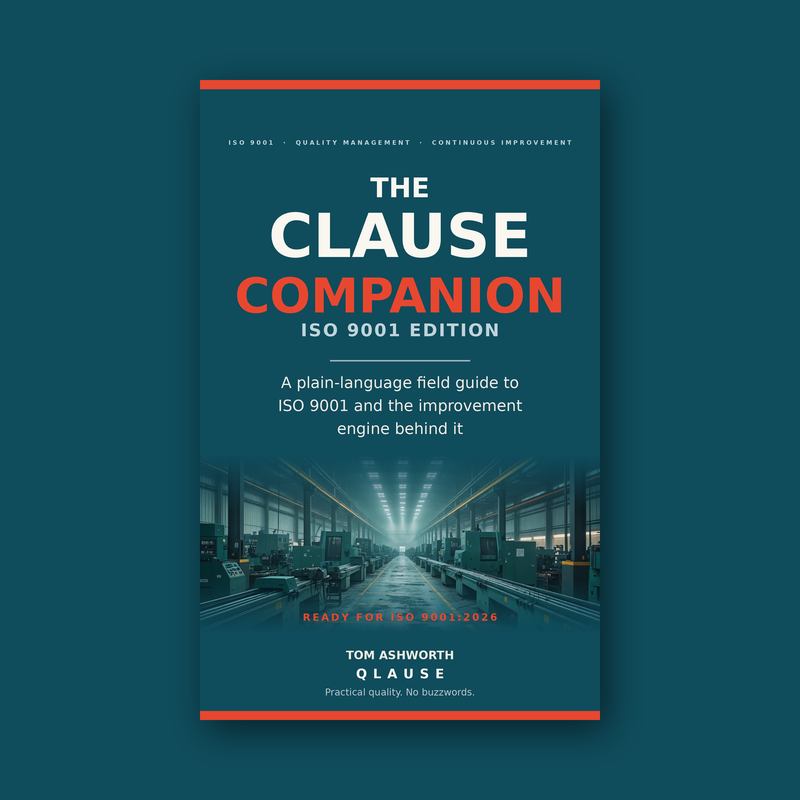
ISO 9001 Edition
A plain-language field guide to ISO 9001 and the improvement engine behind it
- Every clause family gets the same six treatments — what it is about, what the standard is really asking, what auditors look for, what evidence satisfies, how to make it work in practice, and where companies stumble
- Updated for the published ISO 9001:2026 — a shaded box in every clause family shows what changed from 2015, plus a phased transition checklist set against the transition dates
- Part III goes past the certificate: daily management, the constraint that decides where improvement turns into money, problem-solving that holds, control charts without statistics-fear, and the habit that survives week thirty-seven
- A thirty-minute self-assessment, the smallest honest document set a real QMS needs, and a starting-from-zero route to a first certificate
- Honest about the standard's warts — including the one word clause 6 leans on and never defines
For: Managers, quality leads and owners of certified (or certifying) organisations outside automotive supply.
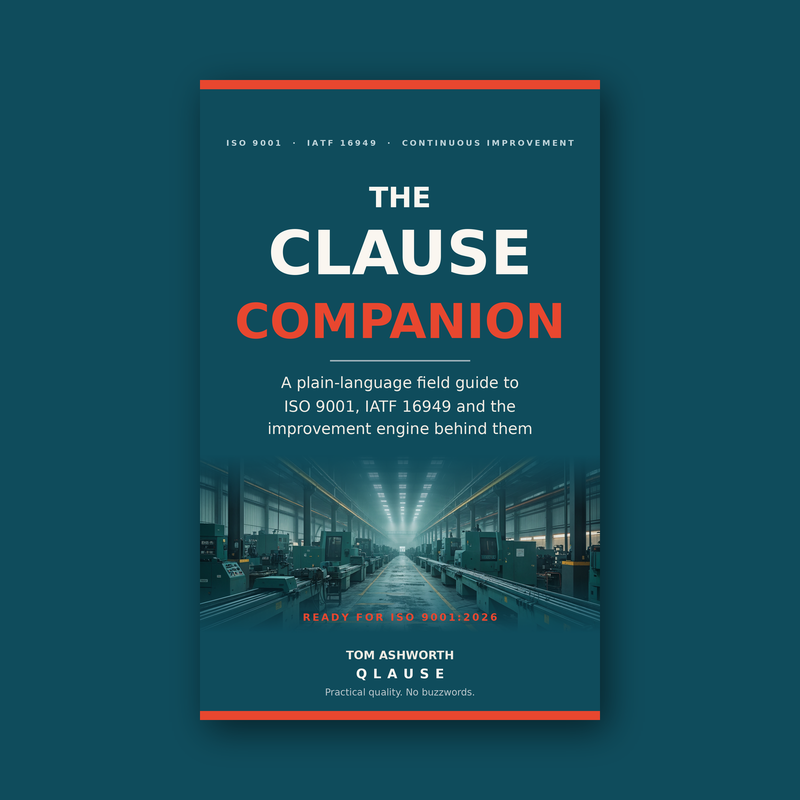
Automotive Edition
A plain-language field guide to ISO 9001, IATF 16949 and the improvement engine behind them
- Everything in the ISO 9001 edition, plus 46 IATF 16949 sections in the same six-block format
- The automotive requirements that actually generate findings: customer-specific requirements, control plans, MSA, stop-ship authority on every shift, the three internal-audit layers, error-proofing, warranty and NTF
- Updated for the published ISO 9001:2026 — every clause family shows what changed from 2015
- Part III goes past the certificate: daily management, constraints, problem-solving, SPC and sustaining improvement
- A thirty-minute self-assessment, a document starter set, and a 2026 transition checklist
For: Plant and quality managers in automotive supply, and anyone holding or pursuing IATF 16949 certification.
Read a sample before you decide
Chapter 1 in full, plus one complete clause treatment so you can see the six blocks doing their work. No email required.
What's inside
Part I — The System You Already Own
- 1The Binder on the Shelf
- 2The Operating System Hidden in the Standard
- 3The Auditor Across the Table
Part II — The Field Guide
- 4Context — The Questions Before the System (clause 4)
- 5Leadership — The Desk Where Quality Lives (clause 5)
- 6Planning — Risk, Opportunity and the Discipline of Change (clause 6)
- 7Support — People, Kit and the Truth About Documents (clause 7)
- 8Operation — Where the Product Is Won or Lost (clause 8)
- 9Evaluation — Reading Your Own Instruments (clause 9)
- 10Improvement — Closing Loops for a Living (clause 10)
Part III — The Improvement Engine
- 11The Daily Machine
- 12The Machine That Owns the Month
- 13Solving Problems So They Stay Solved
- 14Listening to the Process
- 15The Habit of Better
Plus the back matter that gets used: a thirty-minute self-assessment, the smallest honest document set a real QMS needs, a 2026 transition checklist, a starting-from-zero route to a first certificate, and a plain-English glossary that is honest about where the standard itself is vague.
A note on the author
Tom Ashworth is a pen name. The author has spent a long career in manufacturing quality and operations, in more than one industry, and has sat on both sides of the audit table. He writes under a pen name because he wants the book judged on what it says, and because the plants and people in these pages deserve not to be identifiable: every Field Note is a composite. He is not a consultant, which is why the book is free to say where the standard is badly written and where certified companies are running a polite fiction.
Get the free ISO 9001:2026 Readiness Scorecard
Free, instant download. We'll only email you the occasional practical quality update — no spam, unsubscribe anytime.
The Clause Companion is an independent, interpretive guide. It is not affiliated with, endorsed by or licensed by ISO, the IATF, any national standards body, certification body or accreditation body, and it does not reproduce the text of any standard — you need your own licensed copy.